Home » Posts tagged 'shark week'
Tag Archives: shark week
Prehistoric Shark Week, Day 5: From Whence the Great White?
Greetings and welcome to the final day of Prehistoric Shark Week! All week we have covered sharks that swam in Arkansas during the Cretaceous Period. The dinosaurs get all the press, but we had a diverse marine ecology during that time. Last week, we met a few of the non-shark denizens, such as mosasaurs, elasmosaurs, and more. This week, we have seen nurse sharks, goblins, sand tigers, and an array of rays, skates, and angel sharks. We wrap up the festival of marine animals with the question that everyone wants to know. Where did the most famous sharks of all time, the Great White and Megalodon, come from and how does Arkansas play into this?
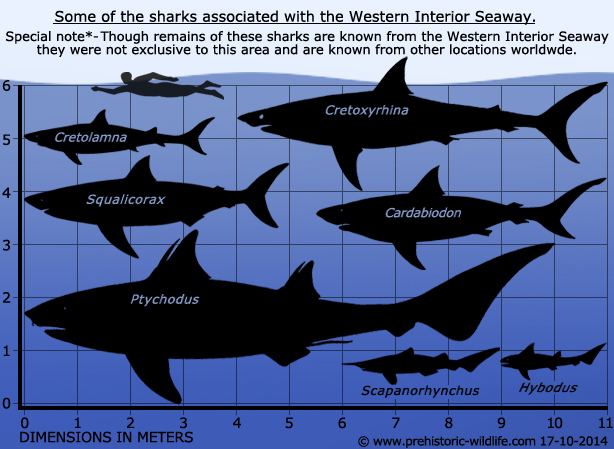
A collection of galeomorph sharks that made their home in Cretaceous Arkansas and much of the world’s oceans, appropriately scaled.
The Great White, or simply White Shark, is named Carcharodon carcharias, meaning sharp tooth pointer, although more popularly named for its white belly, is well known as the largest living predatory fish in the sea, reaching up to and, probably over, 20 feet. Megalodon, listed either as Carcharocles megalodon or Carcharodon megalodon, depending on whether or not one believes it is directly related to or convergent with White Sharks, is the largest known predatory fish ever, reaching sizes up to three times that of the White Shark. It appeared in the fossil record about 16 Mya, but went extinct 1.6 Mya (contrary to what a fictitious documentary on the Discovery Channel claimed).
During the Cretaceous, the southwestern part of the state was covered by the Western Interior Seaway, which for us, was essentially equated to having the Gulf coast not just on our doorstep, but flooding it. Those waters were warm, rich in nutrients, and a hotbed of marine life. In those waters, a few sharks of interest made their home.
All of the sharks we will be talking about are lamniform sharks. These sharks are known for being at least partially endothermic, meaning they used their core muscles to create their own heat and maintain an elevated body temperature, giving them the ability to be active hunters even in cooler waters. Of course, it also meant they were hungrier, needing more food, keeping them always on the prowl. This is what allows the White to be such a fearsome hunter today, giving it the power and energy to breach completely out of the water during attacks.
Squalicorax is an extinct shark of the time that is commonly thought to have resembled Whites. These sharks got up to five meters, although they were typically around two meters. Squalicorax is also called the Crow Shark, which some people have speculated it got that name from evidence of its scavenging. However, squalus means shark (and is the scientific genus name for dogfish) and corax means crow, so the name Squalicorax literally means crow shark. 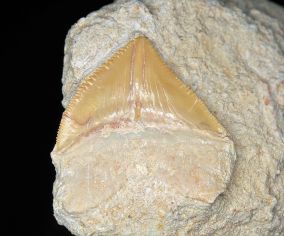 Now as to why it was named that way to begin with, no one knows because when Agassiz named it in 1843, he didn’t leave a record as to why. They hunted and scavenged a wide range of animals, everything from turtles to mosasaurs. Unfortunately, the relationships between Squalicorax and other lamnids is uncertain, so whether or not it could have been ancestral to anything, much less Whites or megalodons, is unknown at present.
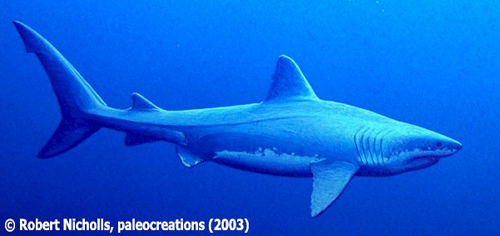
Squalicorax. www.elasmo-research.org
Another candidate is a shark named Isurus hastalis, an Oligocene shark that lived 30 Mya. Isurus also includes the modern day mako shark. However, a researcher by the name of Mikael Siverson concluded that the Isurus teeth were not makos, but worn down teeth similar to modern Whites. So he changed the name to Cosmopolitodus. It has also been suggested that these sharks originated from a shark called Isurolamna, which lived in the paleocene 65-55 Mya.
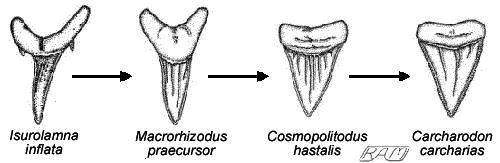
Possible evolutionary sequence of the Great White. http://www.elasmo-research.org
A more recent view, and one which I back (with freely admitted bias because it allows me to say they evolved from Arkansas sharks:) ), is that both Whites and megolodons evolved from an extinct lamnid called Cretolamna, the Cretaceous lamna. This shark had large, strong teeth and was very successful. It had a worldwide distribution and lived from the Cretaceous to the Paleocene. Cretolamna fossils have not been reported in Arkansas thus far, but they were a member of the family Cretoxyrhinidae, of which the shark Serratolamna was a member. The teeth of Cretolamna and Serratolamna are extremely similar, as one might expect from genera in the same family. However, Serratolamna teeth have serrations and Cretolamna does not, making Serratolamna teeth closer in shape to the White Shark. Serratolamna did not have the same worldwide distribution and did not last as long as long as Cretolamna, though. It is impossible to tell which one was directly ancestral to the later sharks, but Cretolamna, due to its more cosmopolitan range, has gotten the nod. It was named first and is much better known than Serratolamna, giving it an edge when people find and identify fossil shark teeth. Thus, it is not a big stretch to say that Serratolamna, or a very close relative, eventually evolved into Carcharodon carcharias as well as Carcharocles (or Carcharodon) megalodon.
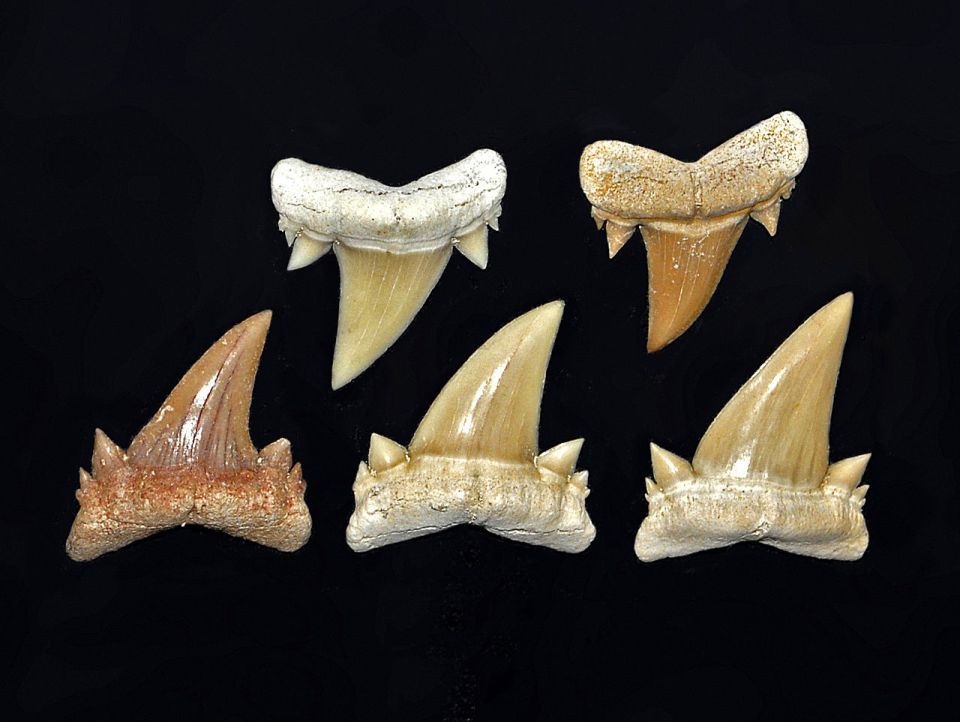
Serratolamna gafsana. Wikipedia. Photo by Hectonichus.
I hoped you have enjoyed Prehistoric Shark Week and the previous week of Cretaceous Arkansas marine predators. Let me know if there is another group that you think deserves special consideration for a celebratory week.
Prehistoric Shark Week, Day 2: Goblins
For Day 2 of Prehistoric Shark Week on paleoaerie, we are going to take a look at my personal favorite shark. In the late Cretaceous, it was called Scapanorhynchus, the spade snout. But its closest living relative is called Mitsukurina owstoni, also known as the goblin shark. The perfect shark for Halloween.

Scapanorhynchus lewisii. Wikipedia
Scapanorhynchus means spade snout, so named for the elongated, flat snout, the same feature which got the modern shark named goblin. Most of them are small, less than one meter, but can get in excess of four meters. Spade snouts were some of the earliest sharks in Neoselachii, the modern sharks. One of the things this means is that they did not just have straight cartilaginous skeletons, they calcified most parts of the skeleton to reinforce the cartilage. They didn’t make true bone, but the calcium spicules provided more strength for the cartilage.

Scapanorhynchus texanus. http://www.njfossils.net/goblin
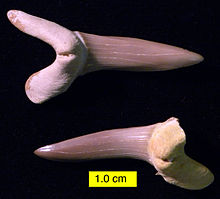 Goblin shark teeth are long and thin, looking like a mouth full of curved needles. But what most people are fascinated by is the amazing length to which they can protrude their jaws. Modern sharks have what is known as hyostylic jaws, meaning that the jaws are not directly connected to the skull. Instead, they are attached at the back of the jaws on an intermediary bone that allows the jaw to swing forward. All sharks can do this to an extent, but the goblin shark is expecially known for it.
The modern goblin sharks are generally only found in deep water. Its Cretaceous cousins, on the other hand, were widespread in shallow marine areas. Like many fish in the Cretaceous, they seem to have survived the mass extinction even at the end of the Mesozoic by going deep.

 paleoaerie