Home » Mystery Monday (Page 6)
Category Archives: Mystery Monday
Fossil Friday, to bear or not to bear, that is the question
It’s Friday again. Were you able to get the answer to Monday’s fossil?
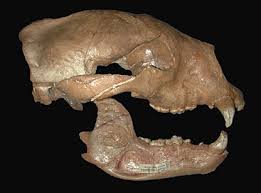 The skull shown in the picture belonged to Arctodus simus, the giant, short-faced bear (the not-so-giant short-faced bear, A. pristinus, was smaller and lived in more southerly areas than A. simus). Arctodus lived in Arkansas and much of North America during the late Pleistocene, from less than 1 million years ago up to about 12,000 years ago, when most of the large North American Ice Age fauna went extinct. Arctodus was the North American version of the European cave bear, Ursus speleaous. While the European cave bear was a close relative of most modern bears, Arctodus was more distantly related, its only living relative being the spectacled bear, Tremarctos ornatus. It is sometimes considered possibly the largest terrestrial, mammalian carnivore that ever lived, standing over 3.5 m ( 11.5 ft) tall. Even on all fours, it was almost 2 m (6.5 f) at the shoulder. You would have to get at least 4.5 m (almost 15 ft) up a tree to avoid its reach, assuming it didn’t just tear the tree down or shake you out of the tree. It weighed in at a full ton and could run 40 mph (over 60kph). However, that is also the top range of modern Kodiak brown bears, otherwise known as Alaskan grizzly bears. In the wild, the bears don’t usually get over 1500 pounds (although they can), but the largest ever known was a bear in the Bismarck, ND zoo that weighed 2130 lbs at his death and previously weighed possibly close to 2400 lbs, although he was a very fat bear. There is another bear pelt on display at Space Farms Zoo and Museum in New Jersey that is claimed to be from a bear over 12 ft. tall and over 2,000 lbs, but those claims remain unverified are considered by most to be exaggerated. There is another bear that may have been even bigger. Arctotherium angustidens lived in South America about three million years ago and stood almost 3.5 m tall, so similar to Arctodus and the largest of extant bears, but was much more robust, weighing in the neighborhood of 3,500 lbs.
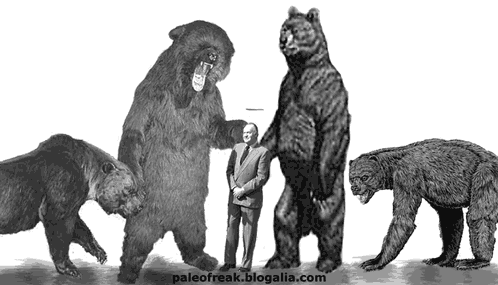
Arctodus is generally known for its long legs and short face. However, research in the past decade has indicated that its legs were neither longer than expected, nor was its face all that short. It was simply big. Like other bears, it is thought to be fairly solitary most of the time. Contrary to many depictions, it was not particularly adapted to running quickly, considering that modern grizzlies can run 30 mph. What may have made people think they were unusually fast is a combination of their size giving them long legs and tracks that have indicated they used a pacing gait, with the legs on the same side of the body moving in unison, rather than in opposition like most other animals. This sort of gait is typically used in animals with longer legs or at faster trots. Camels use it and dogs and cats, among others, do it when maintaining a trot before they break into more of a gallop. However, the pacing gait is not indicative of a fast-running animal, but of an animal that maintains a quick pace for long distances, it bespeaks of endurance, not speed.
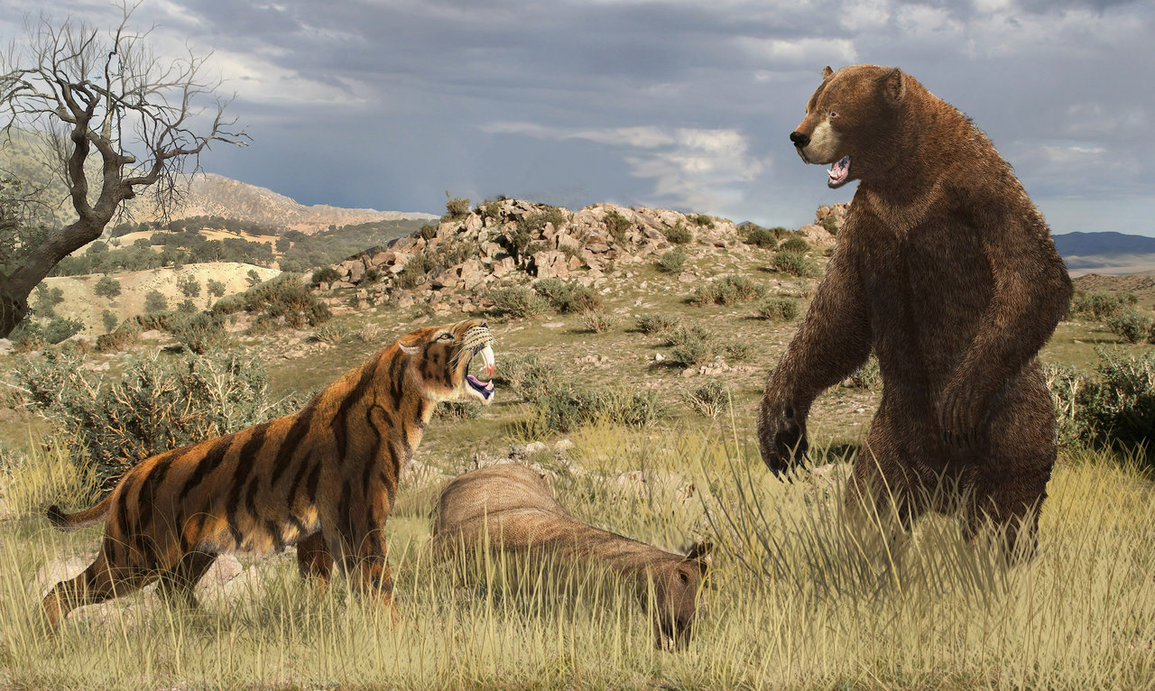
Like most bears, Arctodus is thought to have been omnivorous, eating both plants and animals. There have been several hypotheses concerning its diet, from mostly scavenging to hypercarnivorism. It was certainly capable of bringing down large prey, although its limbs were not as flexible as most high level predators, nor were they particularly robust for their size, leading some to think they scavenged, although they would be hard-pressed to compete with giant vultures in scavenging and recent work indicates the tooth structure was not sufficient for chomping through bone. They may have been better suited for foraging plant material with their unusually flexible wrist giving them an almost semi-opposable thumb, much like pandas. This suggests possible tree-climbing to some workers, although Arctodus was a very large animal to be climbing trees. Besides, it typically lived in more open, grassland environments the majority of the time, so it is unlikely to have been adapted for tree-climbing.
They went extinct roughly 11,000 years ago, along with a large number of other large species. A reduction in rich food supplies is thought to have caused the extinction of the large herbivores. This would have placed a great deal of stress on the carnivores, causing increased competition. The dire wolves lost out to the modern grey wolves during this time, chiefly thought to be a result of the gray wolves being able to hunt and subsist on smaller and fewer prey than the larger dire wolves. This same reasoning would apply to Arctodus as well, which had to compete against both wolves and other bears, for a greater percentage of the share to fuel its larger body. On the other hand, evidence for this hypothesis has been lacking in analyses of tooth wear.
If you want to see more of Arctodus, make your way to the La Brea Tar Pits in Los Angeles. many bones of this bear have turned up from the tar and are on display at the Page Museum.
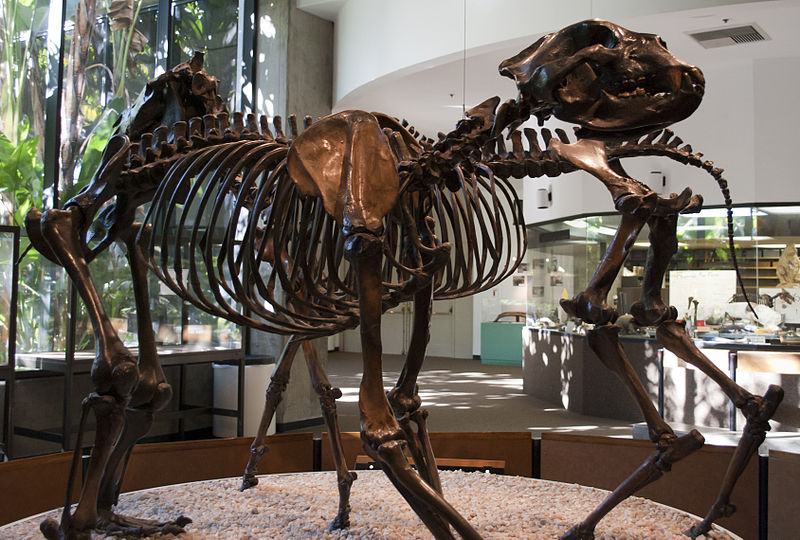
Arctodus from the la brea Tar Pits at the page Museum. Wikipedia.
Mystery Monday, snow edition
The weather forecast this week is for snow. So in going with the theme lately of Ice Age animals, I thought I would bring you another one for this week’s Mystery Monday fossil. This picture doesn’t have a scale, so I will just say this skull is bigger than yours (under the assumption that all my readers are Homo sapiens or within the same size range, my apologies to the exceptionally macrocephalic).
Mystery Monday Fossil of the Week
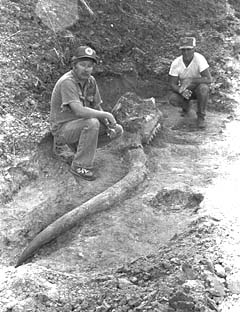
Our Mystery Monday fossil concerns a photo taken by the Arkansas Archaeological Society on one of their digs. I’m still trying to find when this was taken, but I know roughly where. Can you tell what it is they are uncovering?
Fossil Friday
On Monday I posted a picture of a tooth from an animal that is a famous California resident, although is not generally considered an Arkansan. Were you able to figure it out?
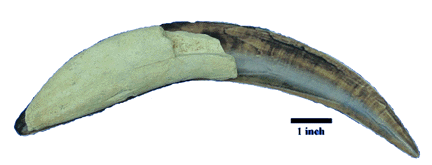
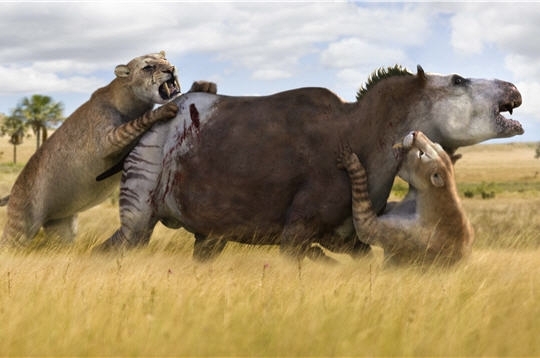
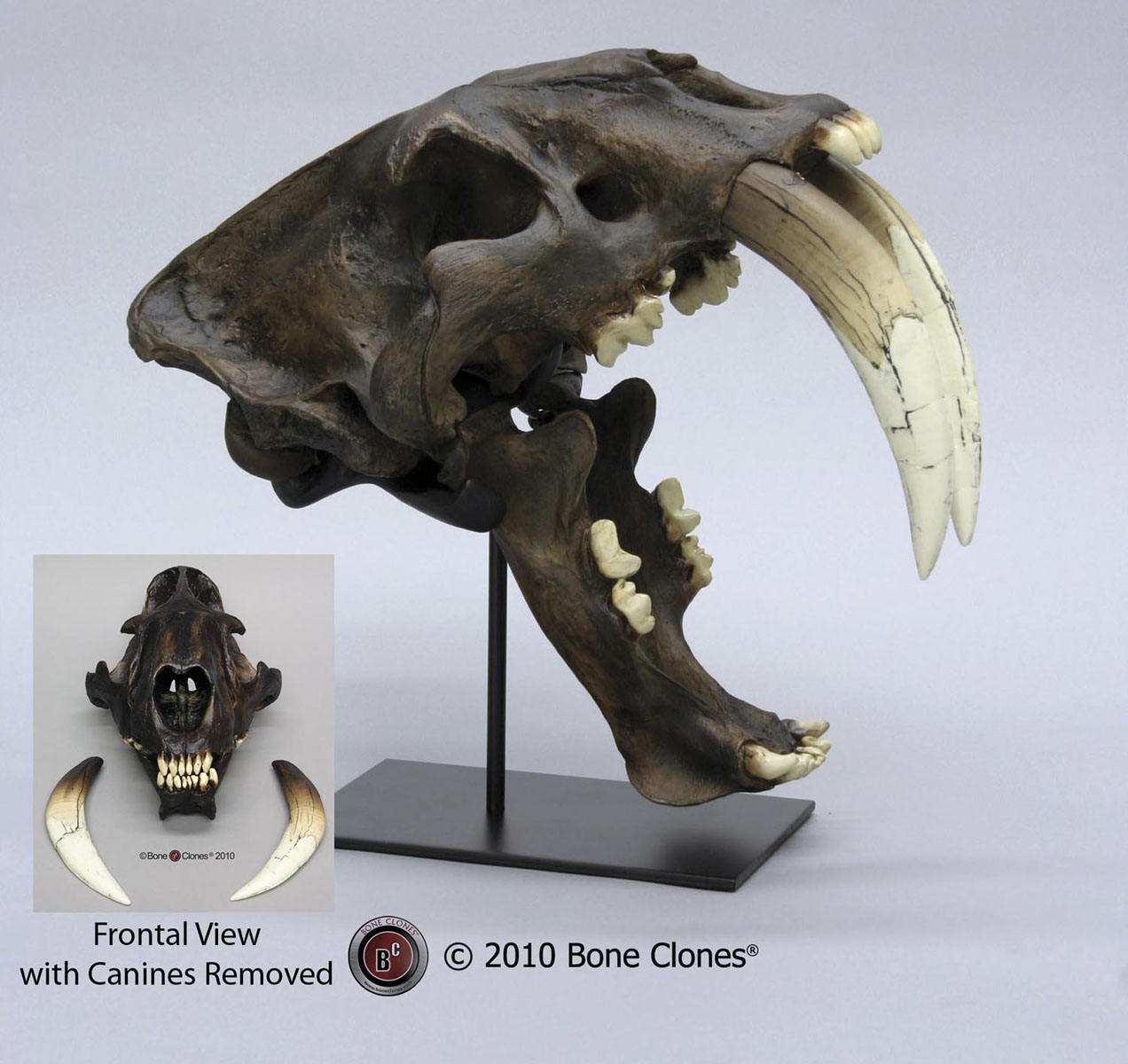 The tooth is a canine from a Smilodon, the saber-toothed tiger (although not actually related to tigers). Smilodon fossils have been found in a few caves in the Ozarks of northern Arkansas, most notably Hurricane River Cave and the Conard Fissure (the Conard Fissure was excavated by Barnum Brown for the American Museum of Natural History, who also did a lot of famous dinosaur digs for them in the Rockies) . Originally, they were described as having come from two different species of Smilodon: S. fatalis and S. floridensis. Smilodon fatalis, sometimes called S. californicus, is well-known from the La Brea Tar Pits in California, although has been found throughout much of North America and Pacific coastal areas of South America. Smilodon floridensis was known primarily from, unsurprisingly, Florida and neighboring states. However, these days most researchers view them all as the same species, so just Smilodon fatalis. There are two other recognized species. Smilodon populator lived in South America and was bigger, with a few hundred more pounds on S. fatalis. Smilodon gracilis was half the size of S. fatalis and lived earlier than either of the other species, and is considered by some to be ancestral to them.
prehistoricpark.wikia.com
Smilodon fatalis is the quintessential Ice Age predator. It appeared about 2.5 million years ago and only died out about 10-13,000 years ago, so it may have been possible that Smilodon preyed upon early humans, at least along the Pacific coastal areas. It was a big, burly cat weighing up to 600 lbs. with heavily muscled forelimbs. Of course, it is best-known for its 7” long, serrated canines, thus the name Smilodon, meaning “carving knife tooth”. Smilodons were part of a group known as Machairodontinae, a subfamily within Felidae known as the “dirk-toothed cats.” These long teeth necessitated a jaw that could swing extraordinarily wide. Smilodon was specialized for killing large prey, such as bison, horses, and young mammoths and mastodons. Much debate has centered on how it dispatched its prey, with depictions of a Smilodon burying its canines in the skull or eviscerating its prey. However, more recent studies have indicated the canines were too fragile to withstand such treatment or couldn’t get a sufficient bite to properly tear into the abdomen. It is thought instead that Smilodon used its powerful forelimbs to stun and restrain the prey until it could bring its canines into play with its powerful neck muscles to slash the throat and cut the major arteries, causing the animal to bleed out quickly. They were not fast runners, preferring to attack from ambush, staying hidden within the vegetation of the forests and bushlands it preferred to live in.
Youngsteadt J.O., 1980: A saber toothed cat smilodon floridanus from hurricane river cave northwest arkansas usa. Nss Bulletin: 8-14
B. Brown, The Conard Fissure, A Pleistocene Bone Deposit in Northern Arkansas…,Memoirs of the American Museum of Natural History, Vol IX, Part IV, February 1908.
Fossil Friday
Another week has gone by and so little done here. I started my Vertebrate paleontology class this week and if you think it takes a lot of work to take one, just imagine the amount of time it takes to design one.
So today, we announce the mystery fossil from Monday. Did you have any idea what it was? It stumped everyone on the Facebook page, so if you couldn’t figure it out, don’t feel bad. It was a hard one. These are not terribly uncommon fossils, but most people are completely unfamiliar with them, despite the fact that anyone who visits a public aquarium has seen its living relatives.
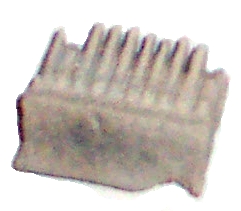
This is part of a tooth plate from a ray, most likely Aetobatus, the eagle ray. They are filter feeders eating plankton and have been around since the Miocene 20 million years ago. While none have been found in Arkansas that I know of, they have been found in pretty much every state around us, so I expect so collector out there somewhere has probably found some here. Check us out Monday for a new fossil!
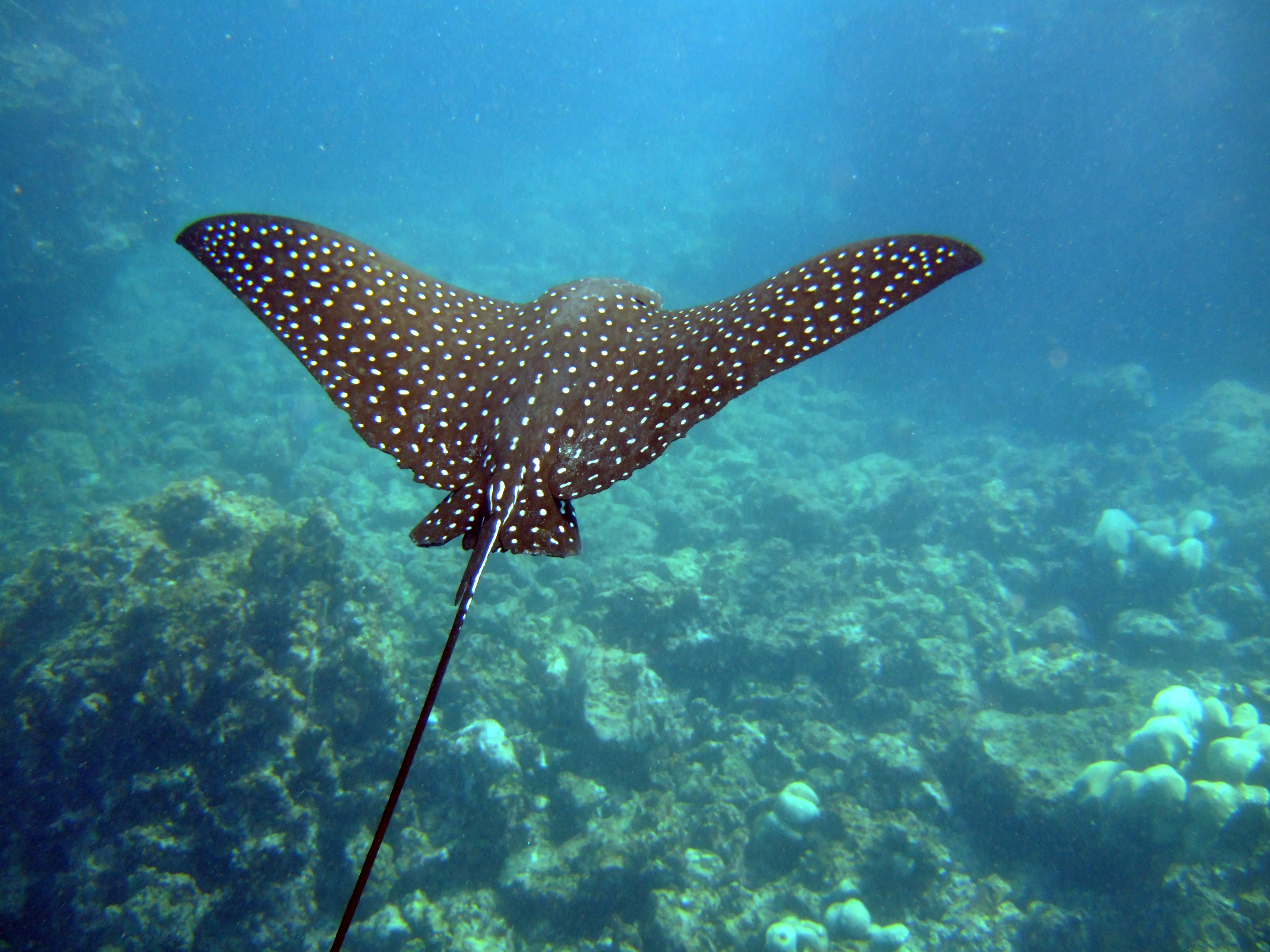
Spotted_Eagle_Ray_(Aetobatus_narinari). Wikipedia.
UPDATE: I need to correct a mistake I made in this post. Eagle rays, like Aetobatis here, were and are not filter feeders. The large rays, like the Manta ray in the same family, are indeed filter feeders, the smaller rays, like Aetobatus and its close relative Myliobatis, another ray that lived in the area at the same time (as well as earlier in the Eocene over 40 million years ago), were durophagous, meaning they used their teeth to crush shelled prey, such as clams, crabs, and shrimp. The main part of the tooth brought to bear on the prey item is the flat, plate-like part.
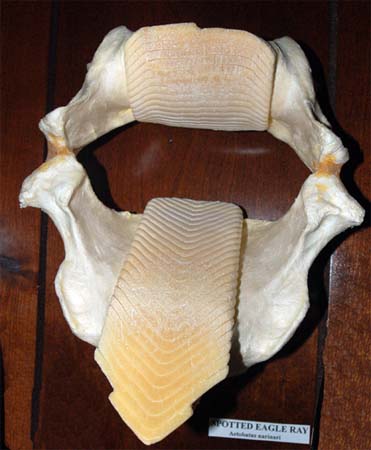 For this picture and much more information on the current species of eagle rays, go to the Florida Museum of Natural History.
Mystery Monday and Walking With Dinosaurs Movie Review
Mystery Monday
Last Friday I posted clues to a mystery fossil. The clues were 1) I lived in AR during the Mississippian Period roughly 330 million years ago and am a very common fossil to find here. 2) Many people think I’m a coral, but I’m not. 3) I am named after a famous Greek mathematician and inventor. Who, or more precisely, what am I? Allie Valtakis got the right answer as the bryozoan, Archimedes. Here is what the Arkansas Geological Survey says about it.
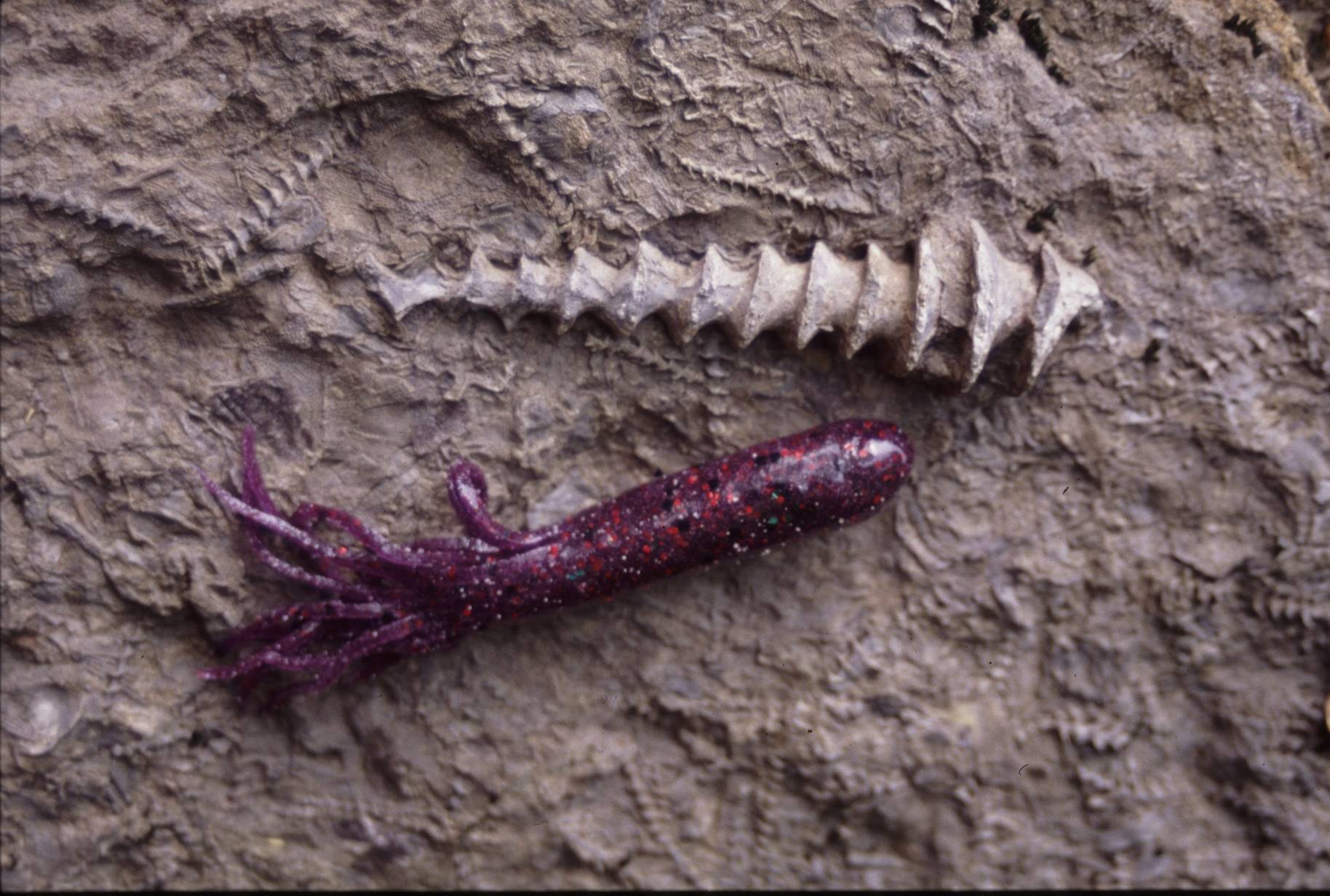
The Bryozoa grow attached to the sea-floor as do corals, but they differ significantly from corals in terms of soft-part anatomy. The bryozoans are exclusively colonial and fall into two broad groups, the lacy colonies and the twig-shaped colonies. Individual “houses” (zooeciums) lack the radial partitions found in corals, but they are divided transversely by partitions called diaphragms (Fossils of Arkansas). Bryozoans can also grow as incrustations on the shells of other organisms and are commonly associated with reef structures.
“Bryozoans are tiny colonial marine animals that are present in marine and fresh water today. They are sessile benthonic animals (fixed to seabed) that are filter feeders and prefer shallow seas, living fairly close to shore (neritic). One bryozoan called Archimedes (see picture below) is abundant in Mississippian age rocks in Arkansas and is so plentiful that one of the rock formations called the Pitkin Limestone was once referred to as the “Archimedes Limestone”. Generally, only small pieces of bryozoans that resemble “fronds” are preserved in Mississippian and Pennsylvanian age rocks in the Ozark Plateaus Region.
References:
Freeman, Tom, 1966, Fossils of Arkansas: Arkansas Geological Commission
Bulletin 22, 53 p., 12 pls., 15 figs., 1 map.
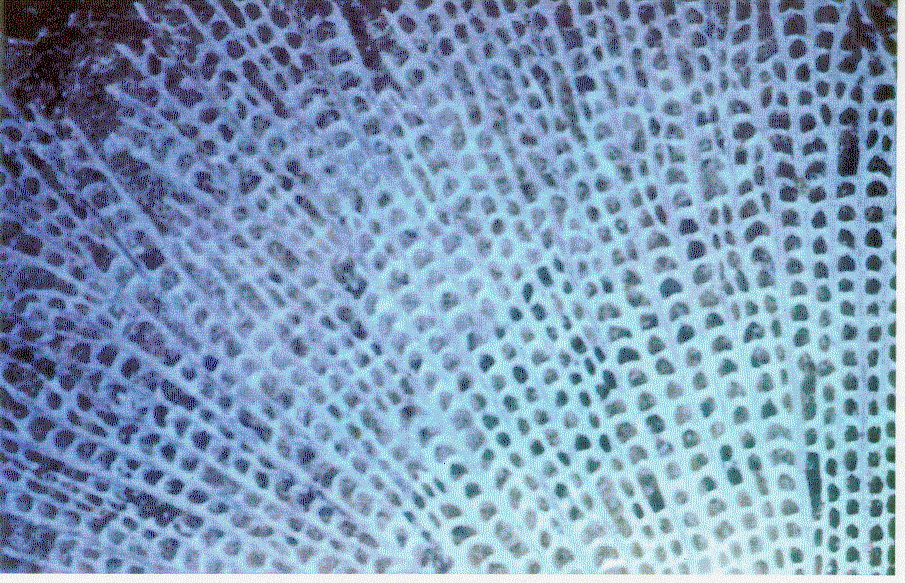
Archimedes “fronds”
Way to go, Allie!
Can you guess this week’s fossil? I will do things a bit differently this time. Unlike previous fossils, in which I told people on the Facebook page as soon as someone provided the correct answer, I will not reveal the answer until Friday, so you have plenty of time to give it a try. In addition to the picture (note the scale) below, I will provide one clue every day until Friday. Good luck!
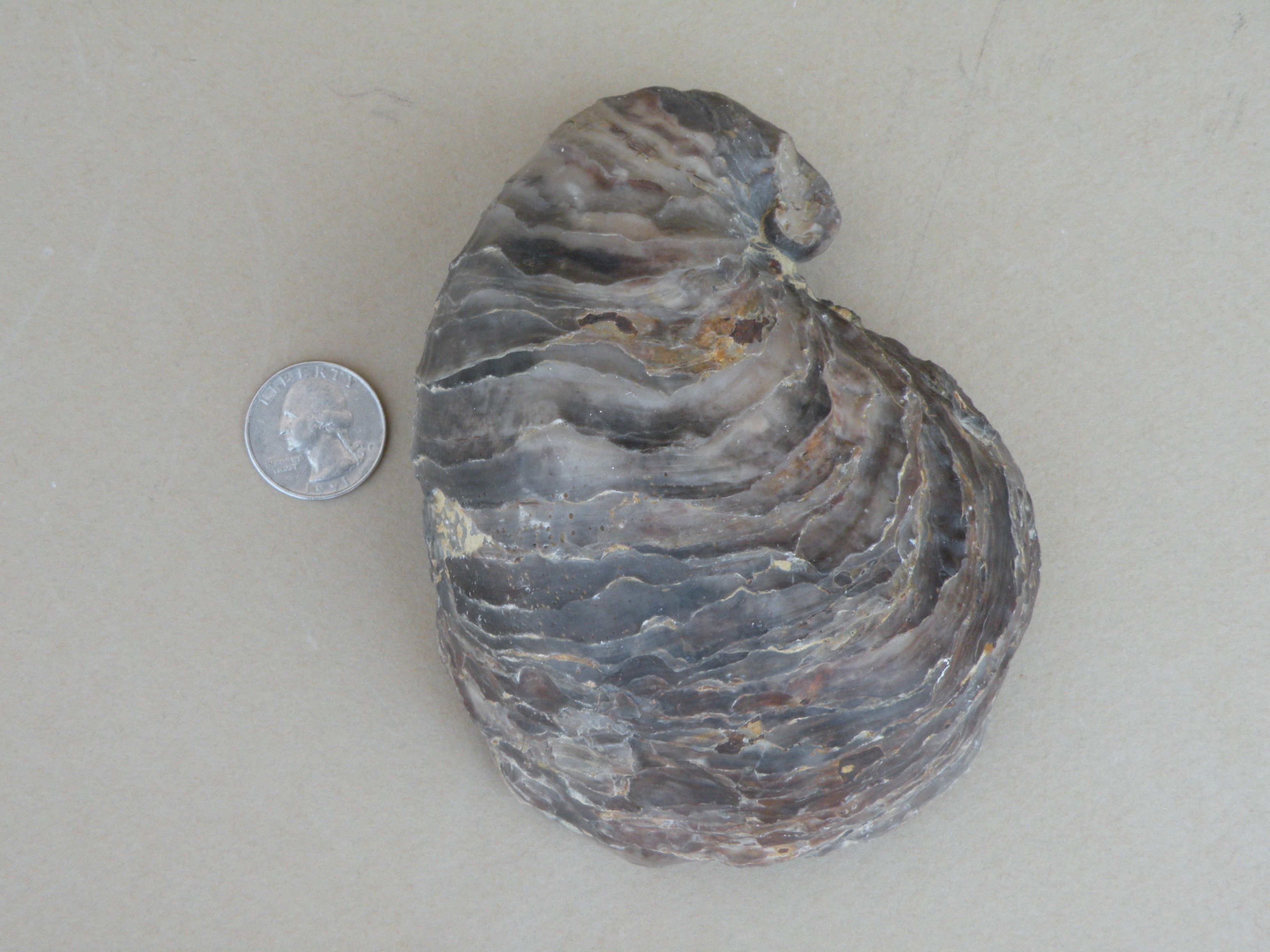
Clue 1: It’s from the Cretaceous.
Clue 2: It’s modern day relatives are widely considered a delicacy.
Clue 3: This is no wilting lily. This creature is big and bold. It shows how twisted it is on the outside for all the world to see. Dude, that’s heavy.
Come back tomorrow for the answer! You can also find it on the Facebook page.
Walking with Dinosaurs 3D movie review
I went to see Walking With Dinosaurs 3D this weekend. My kids were interested in seeing the movie and I liked the BBC “Walking with Dinosaurs” TV mini-series, so we were all eagerly anticipating the movie. I had read a few reviews of the movie, some by paleo people, who said the dinosaurs were great, but the voices were terrible, which gave me pause, but it’s a BBC movie on dinosaurs, how bad could it be, right?
Sadly, not like this.
Sad to say, I have to agree with most of the reviewers. This movie may be much more enjoyable if you can’t hear it. To begin with, whatever expectations you may have, forget them. If you are going in expecting to see a big screen version of the BBC “Walking with Dinosaurs,” you will be disappointed by the cartoon voices and plot. If you are looking for light entertainment for little kids, you might be a bit surprised by the rather jarring breaks providing a subpar, documentary-style educational interlude which will kick everyone out of the story.
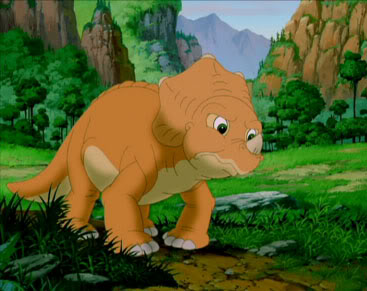
More like this, but with better graphics.
The film reminded me nothing so much as a cross between the BBC documentary-style series and The Land Before Time movie series, failing at both. I think the reason for this is because it seemed to clearly start off with the idea of it being a kid-friendly movie along the lines of the TV series, but some executive decided after it was made that it was not going to draw enough kids. So the movie was recut and really bad dialogue added to it instead of the normal narration one would expect in a nature documentary, along with completely superfluous modern scenes bookending the film, wasting the talents of otherwise fine actors. The voices were obviously added as an afterthought because the dinosaurs do not act like they are speaking. I could even occasionally hear the original dinosaurian bleating and honking in the background even as they are supposedly talking. The dialogue, as Brian Switek noted in his review, destroyed any emotion that may have been evoked by the scenes that were supposed to be emotionally powerful. What should have been poignant, heart-tugging scenes were drained of any impact by juvenile pratterings that never ceased. I found myself wishing for the dinosaurs to just shut up once in a while. As a result, it is a movie that may be enjoyable for a little kid, but eminently forgettable. Bambi was a much more riveting emotional experience, not to mention more educational about the lives of deer.
The story line was inconsistent with the idea of a nature documentary and a poor choice for a dinosaur movie. Whether or not the worst aspects of it were in the original script, I don’t know, but the final plot, while suitable for a cartoon Land Before Time, was wholly inappropriate for a nature “fauxmentary.” For a film that was supposedly educational, it pushed moral viewpoints which are only valid in human cultural environments and completely invalid in the natural world. The idea that intelligence and courage will overcome the thoughtless, testosterone-fueled belligerence of the larger alpha males is a noble sentiment and may work in a human context, but not in the depicted dinosaur society. Control of a herd of large herbivores that have evolved extravagant displays will never pass to the runt of a litter because he saves the herd in a time crisis due to his quick thinking. The plot line for the movie is far more appropriate to an after-school special involving actual, human children, not dinosaurs. As such, it completely destroys any educational effectiveness of the movie. The only education that remains is that dinosaurs lived in a snowy Alaska and that some dinosaurs had feathers, particularly the smaller theropod carnivores. I really like this aspect of the movie, but its authenticity in these aspects was completely undermined by the silliness of the rest of the movie.
To make it even more confusing in terms of genre plotting, the movie shows that females in the herd are dominated by the alpha male, but glosses over what that means in terms of sexual dominance. In a kid-based movie, this understandably only goes as far as hanging out with each other. In the natural world (and post-adolescent human worlds), as every adult in the audience will understand, it means the female submits to the alpha male’s sexual advances. In terms of a human kid’s movie, it sends very poor messages about the role of females in society. In terms of an educational nature show, it is intentionally misleading to spare the typical parental sensibilities of what is appropriate for kids to see.
In short, if you go to see this movie (which I would really recommend waiting until a rental, as it is not worth spending the price for a 3D movie), go expecting to see a mindless 80 minutes of passable, but forgettable, entertainment for children with no real educational value other than to say look, aren’t dinosaurs neat? Enjoy the graphics, ignore the rest.
Happy New Year! Welcome to 2014
 Welcome back! I hope everyone had a great holiday to mark the end of a great year. 2013 marked the inaugural year for Paleoaerie. Version 1 of the website was set up, providing links to a wealth of online resources on fossils, evolution, the challenges of teaching evolution and the techniques to do it well. The blog had 26 posts, in which we reviewed several books and websites, discussed Cambrian rocks in Arkansas and the dinosaur “Arkansaurus,” and went to the annual meeting of the Society of Vertebrate Paleontology. We looked at geologic time and started a series on dinosaur misconceptions. We also had several Forum Fridays, recapping the many news stories reported on the Facebook page. One of the recent things we’ve started is Mystery Monday, posting a fossil of the week for people to try to identify. Speaking of which, to start off the new year, the first mystery fossil will be posted early. look for it at the end of this post.
In the upcoming year, we hope to expand the site, providing many more resources, along with continuing posts on Arkansas geology and fossils, including many more mystery fossils. Stick with us and you will learn about the history of Arkansas in a way that few people know. The site will be revamped to be more user-friendly and enticing to visitors. If plans materialize, we will be adding interactive activities, animations, and videos, many of which will be created by users of the site. Materials from workshops and talks will be posted for people to view and use. More scientists will be posted that have offered their services to teachers and students. We encourage you to contact them. They are there as a resource.
Of course, all of this does not come free. it takes money to provide quality services. Thus, more avenues of funding will be pursued, including other grant opportunities and likely a Kickstarter proposal. You may soon see a small button on the side of the website for Paypal donations. Any money donated will go first towards site maintenance. Other funds will go towards a student award for website design, a 3D laser scanner to put fully interactive 3D fossil images on the site, and materials for review and teacher workshops. If grant funding becomes available, additional money will be spent on research into the effectiveness and reach of the project. But even if no more funding becomes available, you can still look forward to continuing essays on Arkansas fossils, reviews of good books and websites, and curation of online resources suitable for teachers, students, and anyone else interested in learning about the endlessly fascinating history of life on planet earth.
I mentioned at the beginning about the latest mystery fossil. Here’s the first hint: it is a very common fossil found in Arkansas and lived during the Mississippian period roughly 330 million years ago. More hints and photos to come. Leave your guesses in the comments section. Don’t worry about getting it wrong, every success has lots of failures behind it. Errors are only stepping stones to knowledge.
Clue number 2: Many people think I’m a coral, but I’m not.
Clue number 3: I am named after a famous Greek mathematician and inventor.
What am I?
Forum Fridays and Mystery Mondays
Likely thanks to upgrading computer systems and the joys of trying to figure out new setups and operating systems, there seems to have been a small glitch deleting the post that was supposed to go up Friday, so it is getting posted today. So let’s see if we can make lemonade from the lemon.
On Facebook, I started a new set of posts, in which I post a picture of a fossil found in or could be found in Arkansas and see if anyone can identify it. The first one I put up was of a mosasaur, a huge aquatic reptile that swam around Arkansas seas during the Cretaceous Period. People seemed to enjoy it, so I will be doing this on a regular basis. However, it has come to my attention that many places block Facebook, including a lot of schools. So I will be posting them on the blog. I will try to post a new picture every Monday and will then provide the answer on Friday, giving people the week to see if they can come up with the answer. Don’t worry about being wrong, we learn more from our failures than our successes anyway. You can’t win if you don’t play. So with that, let’s play! here is today’s pic. Can you tell me what it is?

In the meantime, if you missed out on all the stuff we covered on Facebook, here is a brief summary of most of hte stories.
Of the many new fossils and work on fossils that were reported on this month, we saw a new fossil primate that may have been ancestral to lemurs and lorises and giant, terrestrial pterosaurs of doom. We learned about the earliest flowering plant in north America, new crests for old dinosaurs and the promise and perils of resurrecting dinosaurs and other extinct animals..
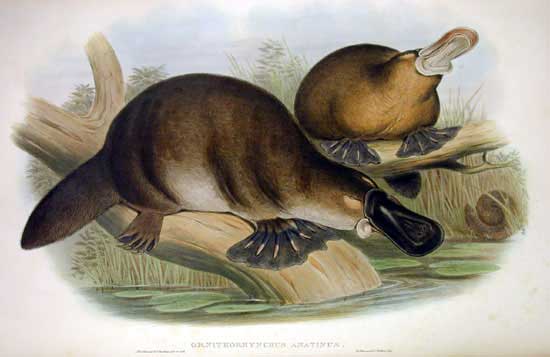
The poor platypus, he has no stomach (but at least he has poison spurs). John Gould. 1863. Wikimedia.
We learned about evolutionary ghosts, how animals colonize new territory, and how unmasking latent variation within a population can lead to rapid evolution.
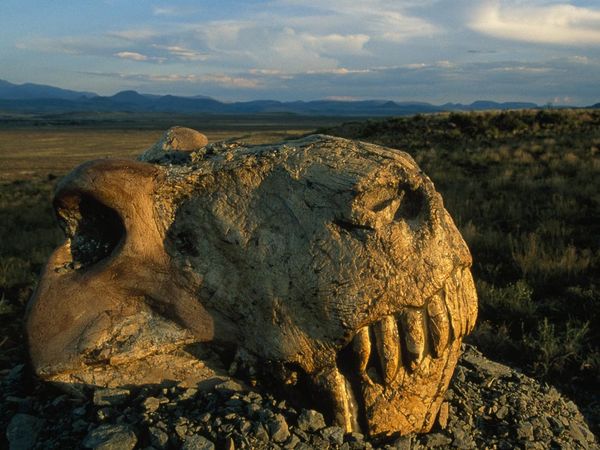
Photo by Jonathan Blair. http://tinyurl.com/n4xzv26
We learned how evolution made it easier for people to believe in God than accept evolution and why fanaticism of any stripe can lead one astray. We read a discussion about the importance of scientists in science communication, and why we shouldn’t ignore Youtube. We found help in teaching controversial subjects in hostile environments and apps to help teach hard-to-grasp subjects like astronomical distance.
We learned about how bacteria avoid the immune system to cause disease, how they form an important part of breast milk, and the four billion year history of vitamins. We learned even bacteria have a hard time living deep inside the earth and how viruses can kill even antibiotic-resistant bacteria. We also read a review of a book on evolutionary medicine.
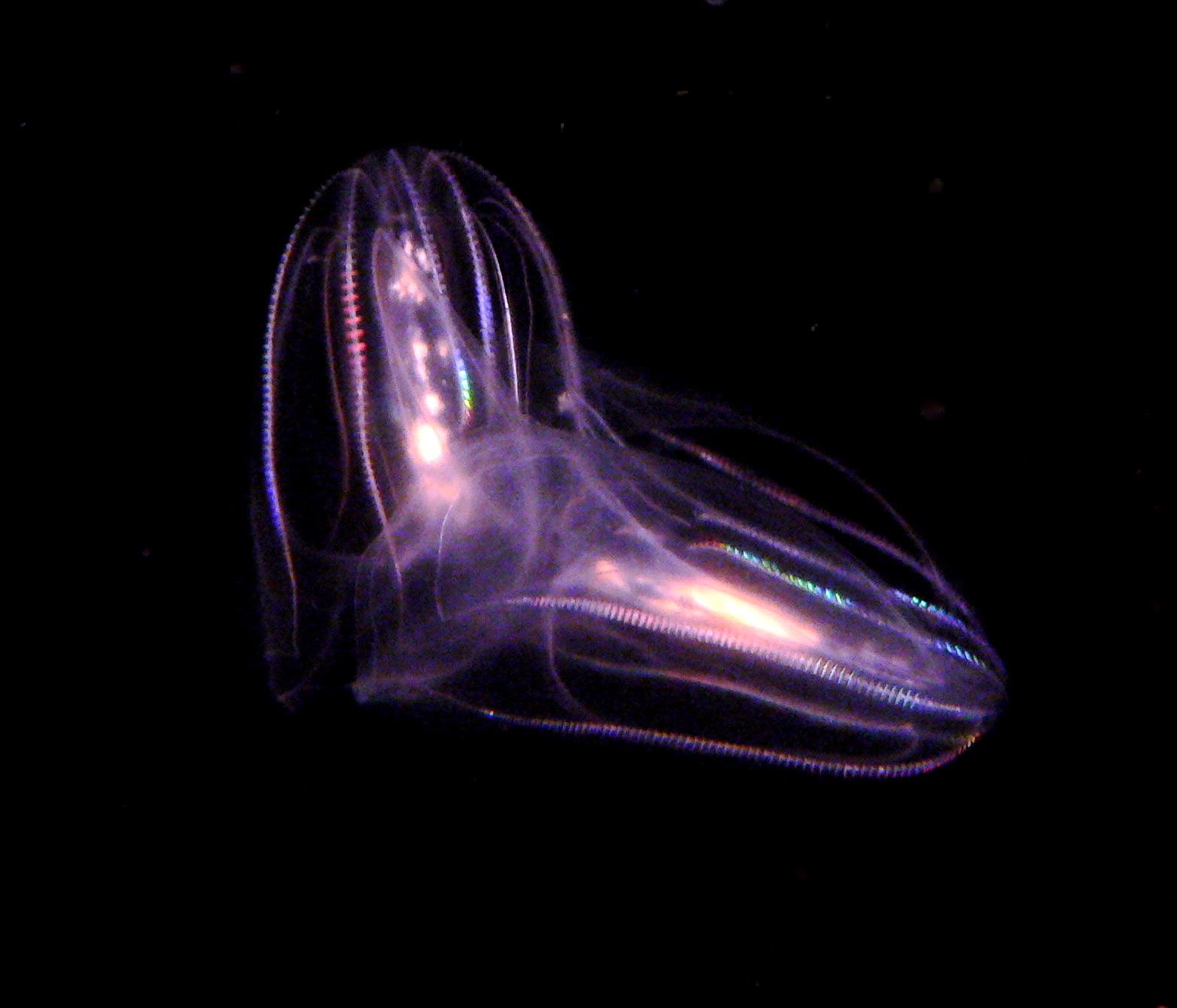
Comb jelly. Wikimedia. Creative Commons Attribution 2.0 generic license.
So, what were the stories you liked? Did it spark any thoughts, either good or bad? Was there anything that you saw that we didn’t mention? Share your thoughts and don’t forget to try your luck with identifying today’s Arkansas fossil!

 paleoaerie