Home » Uncategorized (Page 6)
Category Archives: Uncategorized
The Difference between Scientists in Real Life and Scientists on TV
Many people have an issue with scientists, particularly those studying evolution and paleontology, for making statements they feel are pure speculation. I absolutely agree that people should be upfront about what is known and what is speculation. Most scientists ARE generally clear about that. If you ask most scientists, they will tell you what we know and don’t know. That is actually one of the biggest problems that scientists have with almost all of the shows and most of the books written for the public. Those outlets are not clear about what we really know and what we don’t, what is speculation. Most scientists I know work really hard at trying to clarify that sort of thing and get very frustrated when their words are twisted around. Many scientists have refused to work with film crews for precisely that reason. So please don’t blame the scientists. Write to the shows and demand they are clear about their speculations.

Sadly, I wish I could say all scientists act this way, but it is true, not all do. Scientists are only human after all. There are problems with some scientists. Believe me when I tell you that we recognize this and try to stop it. The lab I worked in to get my doctorate had a reputation for being spoilers, as it were, because a large portion of our research involved figuring out the limits of what the data really let us say and then telling others no, you can’t say that because the data do not extend that far. Our work was very much about separating speculation from reasonable interpretation and fact. But we were hardly alone in that regard, it is something most scientists work hard to do. Paleontology is admittedly one of those fields in which it is easy to take the fossils we have and in our excitement try to say too much about them. So we do our best to restrain ourselves and other workers from extrapolating too far. Go to a paleontology conference and you will see that on display in abundance.

When a paleontologist goes too far, it’s up to other paleontologists to stop them. zetaboards.com by “Dinobear”
Unfortunately, that rarely shows up in material done for the public. The film crews and honestly, most of the public, do not want to hear we don’t know. They want to hear the fanciful stories. Most people get annoyed with scientists when they equivocate and don’t give straight answers. We frequently hear from people, well which is it? Is it this way or that way? If you can’t say with absolute certainty one way or the other, you must not know ANYTHING, when in point of fact, there is a vast difference between not being sure and not knowing anything, I am sure most will agree. But most people don’t want to hear we don’t know with certainty, we can only say this much about it. I have even seen that in my college courses. Many students are uncomfortable with the material I cover in which there are no good answers everyone agrees on. They want definitive answers. A large part of that, I think, is that science is taught in schools very poorly, as a list of facts to memorize, not as a way of thinking and an expanding body of knowledge that is constantly re-examined, with large areas we don’t know yet. In fact, and what makes science fun and interesting for people doing it, is that science is more about what we don’t know than what we do. But happily, I can say that is changing in many areas, with the introduction of more hands-on, exploratory teaching methods.
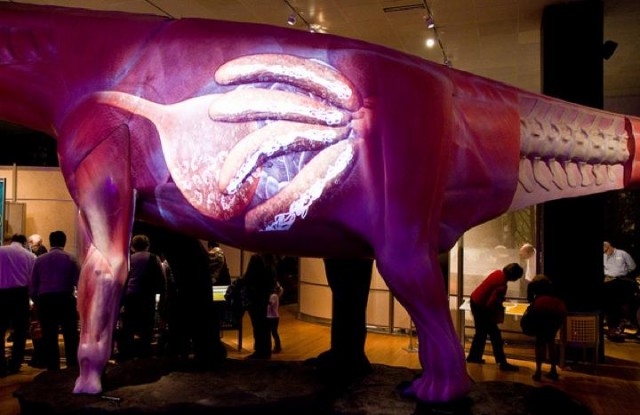
Dinosaur media fail. No speculation without representation! http://www.theawl.com/2011/05/sauropod-swindle-the-monstrous-lies-of-the-worlds-largest-dinosaurs

Get your button here. http://www.etsy.com/listing/50800011/how-does-computer-programming-work-magic
One of the challenges though, is that many things the lay person thinks are pure speculation are not speculation at all, but are backed up by lots of evidence that there is simply not enough time to go into. Many computer programmers simply tell their clients what they do is magic because to answer their questions adequately would take months of training to even get them to the point they could understand the answer. Would you tell a computer programmer what they are doing is pure speculation simply because you don’t understand it? We aren’t trying to be elitest, there is just a lot of information we don’t have time to transmit. There is simply too much going on, too much data, too much research for anyone to keep track of it at all. Even professionals who try to keep up as part of their full-time job can’t do it. So it would be foolish to think anyone who doesn’t spend most of their time studying the research could possibly have a good grasp of the intricacies and quantity of data. It therefore becomes quite the annoyance when people say you can’t know something when they have no idea how much we do know. Many of those things people say we can’t know have been studied for decades by many people who have spent their lives figuring out how to go from speculation to concrete data and hard fact. Most people don’t realize the extreme levels of simplification it takes to get some concepts across because no one can provide all the data backing up those assertions without having their audience earn a graduate degree in the process.
Is all this me telling you to just trust whatever we say? Absolutely not. But don’t expect to come in on the ground floor and know what is going on at the top any more than you could expect to speak perfect French by catching someone speak a few words on TV. Understand that you are only getting the tip of the iceberg. What you see on TV is a seriously flawed transmission of a few grains of knowledge from a mountain range of data. Learn as much as you can from reliable sources. The more you know, the richer your interactions with professionals and the more in depth we can talk to you. We will be happy to share with you everything we know, that’s our job. But what we tell you is highly dependent on the level at which you come to us and the amount of time people are willing to spend. Also understand the quantity of data is more than any one person can understand, even those whose job it is to do so. That is why we have many people studying problems. No one can have all the answers. That is why we keep asking questions. Being open about what we know and what we don’t allows us the freedom to learn more and shows us the path about where to go next. Scientists don’t leave things at speculation, they try to figure out how can we go from speculation to understanding. But if you want to understand all the steps involved, may I suggest grad school?

Mystery Monday

Today we have a picture by Ronny Thomas of a very well-known animal, although it is quite rare in Arkansas. In fact, only one has ever been found in the state. So what do you think it is? Stay tuned for the answer on Friday.
Fossil, and Forum, Friday
I’m sorry, but I forgot to post the Mystery Monday fossil on the blog. I posted the fossil on the Facebook page, but somehow failed to get it posted here, for which I apologize. Here is the fossil I posted, including the identifying portion cropped from the original picture. This image was taken from trilobites.info, a great website for all things trilobite.

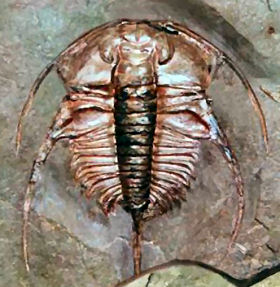
Here is Bristolia for comparison. This image is also from trilobites.info
It was correctly identified as a trilobite, although this one is the species Irvingella, not Bristolia as was guessed. Irvingella is very similar, but lacks the tail spine and the second set of spines is a little farther down the body. They are both listed as “fast-moving low-level epifaunal” feeders by the Paleobiology Database, which means they scurried quickly about over the ocean floor. But whereas Bristolia is thought to have been a deposit feeder, much like a crawfish, Irvingella was a carnivore, preying on worms, bugs, and such. They both lived in offshore marine environments, but whereas Bristolia has been found mostly in shallower waters, Irvingella has been found widespread from offshore throughout the continental shelf and even deeper water. This may have more to do with Bristolia having only been found in a few places in the southwestern United States while Irvingella has a much broader range throughout much of North America and Asia. They both lived in the Cambrian Period, although Bristolia seems to have lived a little earlier than Irvingella (there are some discrepancies in the published records making it difficult to compare exactly, this is partly due to revisions of the time scale and refinements in age estimates over the decades making detailed comparisons problematic).
Since our last Forum Friday recap, we have started a new year. We have reviewed the Walking with Dinosaurs movie. We identified an Exogyra ponderosa oyster, Archimedes bryozoan, Aetobatus eagle ray, and this Irvingella trilobite.
Over on the Facebook page so far this year, we have seen some amazing animals, including sharks that glow in the dark, a fish that walks on land, and a caterpillar who’s tobacco breath repulses spiders. We even learned why sharks don’t make bone, but polygamous mice have big penis bones and an organism that changes its genetic structure seasonally.

A green biofluorescent chain catshark (Scyliorhinus retifer). Livescience.com. Credit: ©J. Sparks, D. Gruber, and V. Pieribone
We saw two articles on fighting dinosaurs. We learned how they took over the planet and discussed scaly dinosaurs for a change. We found out some ancient marine reptiles were black and Tiktaalik had legs.
A lot of articles hit the press on human evolution in 2013. We also found out (some) humans developed the ability to tolerate lactose to not starve and how we smell sickness in others. We also found a great book on Evolution & Medicine. We also saw evidence of how our actions affect the evolution of other animals and someone who thinks they can understand dog language.
We read that plants may have caused the Devonian extinction event, a genetic study saying placental mammals originated before the end-Cretaceous extinction event despite no fossils ever having been found, and that small mammals with flexible schedules handle climate change better than big mammals that keep a stricter schedule.
We found a great , concise explanation of evolution and three different short videos on the history of life on earth, two of them animated and set to music. We also heard Neal DeGrasse Tyson urge more scientists to do more science outreach (and how to cook a pizza in 3 seconds). Unfortunately, we also heard about the deplorable conditions during filming on Animal Planet and creationism in Texas public schools, as well as how the failure to take evolution into account can screw up conservation efforts.
So what did you like? Did you guess the fossil? Is there anything you want to see? Let us know.
Mystery Monday

It’s been a very busy weekend, so this will be a very short post. today I simply want to introduce the latest mystery fossil. This is a bizarre little fossil, measuring less than 2 cm across. It’s not the best picture, I admit, but there is enough resolution to identify it to at least the Order. I will post a clue a day until Friday, when I will reveal its identity. Good luck, take a guess, and have fun.
Tuesday’s clue: These teeth are used to eat animals much, much smaller than the animal it came from.
Wednesday’s clue: We are very popular at many aquariums.
Thursday’s clue: Some people say i have wings, but I do not fly. I may have a cold heart, but I don’t bite.
Happy New Year! Welcome to 2014
 Welcome back! I hope everyone had a great holiday to mark the end of a great year. 2013 marked the inaugural year for Paleoaerie. Version 1 of the website was set up, providing links to a wealth of online resources on fossils, evolution, the challenges of teaching evolution and the techniques to do it well. The blog had 26 posts, in which we reviewed several books and websites, discussed Cambrian rocks in Arkansas and the dinosaur “Arkansaurus,” and went to the annual meeting of the Society of Vertebrate Paleontology. We looked at geologic time and started a series on dinosaur misconceptions. We also had several Forum Fridays, recapping the many news stories reported on the Facebook page. One of the recent things we’ve started is Mystery Monday, posting a fossil of the week for people to try to identify. Speaking of which, to start off the new year, the first mystery fossil will be posted early. look for it at the end of this post.
In the upcoming year, we hope to expand the site, providing many more resources, along with continuing posts on Arkansas geology and fossils, including many more mystery fossils. Stick with us and you will learn about the history of Arkansas in a way that few people know. The site will be revamped to be more user-friendly and enticing to visitors. If plans materialize, we will be adding interactive activities, animations, and videos, many of which will be created by users of the site. Materials from workshops and talks will be posted for people to view and use. More scientists will be posted that have offered their services to teachers and students. We encourage you to contact them. They are there as a resource.
Of course, all of this does not come free. it takes money to provide quality services. Thus, more avenues of funding will be pursued, including other grant opportunities and likely a Kickstarter proposal. You may soon see a small button on the side of the website for Paypal donations. Any money donated will go first towards site maintenance. Other funds will go towards a student award for website design, a 3D laser scanner to put fully interactive 3D fossil images on the site, and materials for review and teacher workshops. If grant funding becomes available, additional money will be spent on research into the effectiveness and reach of the project. But even if no more funding becomes available, you can still look forward to continuing essays on Arkansas fossils, reviews of good books and websites, and curation of online resources suitable for teachers, students, and anyone else interested in learning about the endlessly fascinating history of life on planet earth.
I mentioned at the beginning about the latest mystery fossil. Here’s the first hint: it is a very common fossil found in Arkansas and lived during the Mississippian period roughly 330 million years ago. More hints and photos to come. Leave your guesses in the comments section. Don’t worry about getting it wrong, every success has lots of failures behind it. Errors are only stepping stones to knowledge.
Clue number 2: Many people think I’m a coral, but I’m not.
Clue number 3: I am named after a famous Greek mathematician and inventor.
What am I?
Dig up Digging for Bird-Dinosaurs
Digging for Bird-Dinosaurs: An Expedition to Madagascar
By Dr. Nic Bishop
Publication date 2000. 48 pg. Houghton Mifflin Company. ISBN: 0-395-96056-8.
Nic Bishop has combined his avid love of photography and his doctorate in biology into a prize-winning series of books for children. His books include a series on specific groups of animals, such as snakes, lizards, marsupials, spiders, butterflies, as well as a “scientist in the field” series. It is the latter series I am discussing today. There are plenty of books available discussing the different animals, although few with the quality of photography and biological expertise Bishop brings to his work, but there are precious few that discuss the work of the scientist in bringing that knowledge to light as the discoveries are being made, which is what particularly interests me here.
Digging for Bird-Dinosaurs was published in 2000, so it is not current, but is still topical and relevant and should stay so for some time. The only issues with the age of the book are new details that have been discovered, which further confirm the hypotheses presented in the book. When the book was written, most scientists had been convinced that birds evolve from dinosaurs for many reasons which are mentioned in the book. Since the book has been published, many new feathered dinosaurs have been found which clearly show the relationships in further detail. But the book is not really about the relationships between birds and non-avian dinosaurs, although it discusses them quite well, it is about the experience of the people on an expedition to Madagascar in 1998, what it is like being in the field and the study of some of the fossils that were discovered. If you want to know what it is like to go to another country and dig for dinosaurs, this book will be of interest and should make interesting reading for kids in elementary or middle school.
The expedition was led by Dr. David Krause, a professor at Stony Brook University in New York who has been running paleontological expeditions to Madagascar since the early 1990s and is still doing so, although the book is focused on his colleague, Dr. Cathy Forster, also of Stony Brook (at the time, but now an Associate Professor at George Washington University). She, like Krause, is a noted paleontologist and is likely the focus of the book because of the relative paucity of women in the field sciences. These days, if one goes to a meeting of the Society of Vertebrate Paleontology, women are well represented, but in the 1990s, most of these women were still students looking to the few women like Dr. Forster who were forging careers.

Rahonavis. cc Wikipedia
The book follows their experiences in the field and the discovery of a particularly interesting bird-like creature they eventually name Rahonavis. The book continues with the team bringing the fossils back, preparing them out of the rock and studying them, coming to the conclusion that the animal was the closest known bird to Archaeopteryx, which is generally considered the earliest known bird. It is so close in fact, that many scientists today consider it actually closer in lineage to the dinosaurs known as dromeosaurs, which include animals like Velociraptor, than it is to birds. This placement is a great demonstration that birds really did evolve from dinosaurs. It is so hard to tell the difference between “dinosaur” and “bird” in the earliest bird-like forms because they are not distinct, separate groups. Birds are merely a subset, a type of dinosaur, in much the same way that mice are rodents, which are also mammals, which are also amniotes, which are also vertebrates, etc. Therefore, whether or not Rohanavis falls out before or after Archaeopteryx in the lineage is a mere detail, changing nothing of the story. It makes as much difference to the evolution of birds as it does which of a set of twins was born first or second, a matter of inconsequential minutes in evolutionary time.
One of the fascinating parts of the book is when Dr. Krause and Dr. Forster discuss the local people helping them. The villagers are very poor, with no access to healthcare or schools. Dr. Krause was concerned enough that he founded the nonprofit Madagascar Ankizy Fund, which supplies needed healthcare to the area, as well as building schools and providing teachers. Dr. Krause and Dr. Forster came to Madagascar to hunt for fossils. But while they have found a great many spectacular finds, perhaps their greatest accomplishment is in the humanitarian work on behalf of the people who live there.
But what have you done for me lately?
“No matter who you are, engaging in the quest to discover where and how things began tends to induce emotional fervor—as if knowing the beginning bestows upon you some form of fellowship with, or perhaps governance over, all that comes later. So what is true for life itself is no less true for the universe: knowing where you came from is no less important than knowing where you are going.” Neill DeGrasseTyson. “In the Beginning“. Natural History Magazine. September 2003.
Now that we’ve covered just what this blog is all about and why, it’s time to give you a more detailed look at what we propose to do and what you will find here. On this site, you will find blog posts, links to a variety of websites providing resources and information that have been either put together or verified by content experts, contact information for people that may be of use, and collections of material that are free to use. In the future, we hope to include material created by students and teachers that have been submitted for public dissemination.
The blog on the website will provide essays on several topics. The first and most common will be reviews of books, videos, games, and other resources, both online and off. Because few teachers can afford to go out and buy books for their classroom on a regular basis, they often rely on donations or library book sales to stock their book collections, so reviews will cover a variety of books, both old and new. As a parent myself, I have seen books in classrooms and ones used by teachers that were more than twenty years old. A few are still great books, a lot are either woefully out of date or were terrible to begin with and should be expunged. Hopefully, these reviews will help guide people to books that have quality information in them that are suitable to classrooms. Some books, like The Complete Dinosaur, 2nd edition or The Dinosauria, 2nd edition, are fantastic books, but are in many places rather technical and probably not something most teachers would stock in their classes (although they would have a happy home in a high school library).
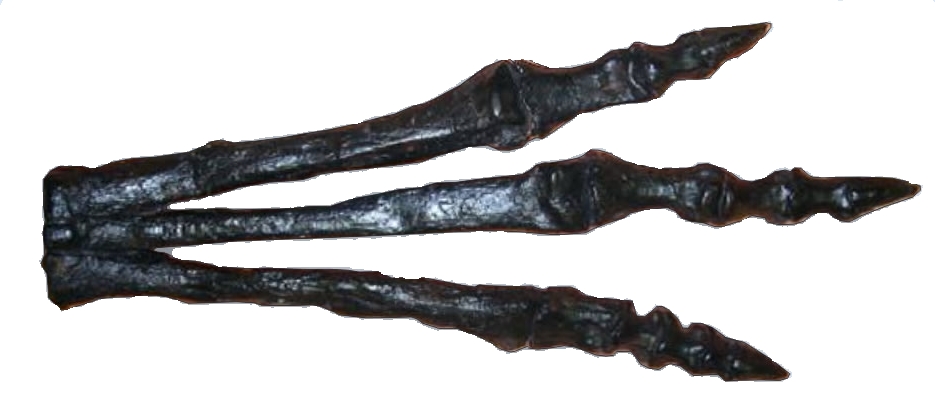
Arkansas’s only dinosaur.
Another series of essays will cover the fossils and geologic history of Arkansas. Arkansas has a variety of fossils, from trilobites and bryozoans, fossil oysters and shark teeth, to saber-toothed cats, mastodons, whales, and even dinosaurs. One series will cover individual fossils highlighting the different types of fossils. If we get funding, we will include a 3D interactive image with every fossil we can. Another series will cover Arkansas through time. We have rocks from the Cambrian to the modern. Each essay will cover a selected time period, tell you where in Arkansas you can find rocks of that age, what type of environments they represent, and what sort of fossils you might find in them. It will take a long time, but should be an exciting series to write and as much fun to read. A third paleontologic series will cover common myths and misconceptions of dinosaurs, other prehistoric animals, and paleontologic concepts.

A simplified image of the Arkansas geologic map, available at http://www.geology.ar.gov
New resources will be added to the website as they become available. Pending funding, a series of teacher workshops are planned, with as much of the material as possible available for free download. Interactive lessons made using SoftChalk, Articulate, or other programs will be added. Additionally, other people are encouraged to design materials that, after being checked for accuracy, will be made available to everyone. The more people participate, the better and more useful the site will be. From teacher-designed tools to student presentations, all accurate and topical material will find a home here.
Education is more than just the transference of information. It is a discussion. An important part of this website will be to put people in touch with each other. Posting information by others is just one part. Discussions of how to teach difficult topics will be another. An important goal of this website is to connect scientists with educators in both formal and informal environments with parents, students and anyone else with an interest in learning more. Together, we can get more questions answered as we find ever more questions to ask. Change may be scary, but refusing to change is to be doomed to failure. Finding the right path forward, the right change, means we keep asking questions and helping each other find the answers.
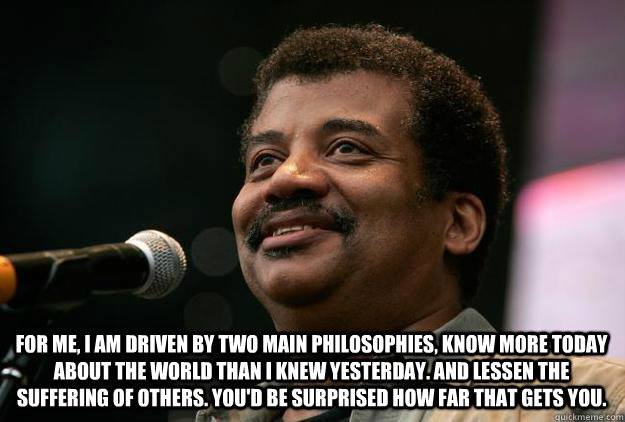
Neil DeGrasse Tyson, Reddit IamI, 2012.
So what’s the problem and what do you plan to do about it?
In the first post, I outlined why I think evolution is important and a few reasons why I think people refuse to accept it. In this post, I will discuss a little more about why it is not taught much in Arkansas and the rest of the United States and what you can expect from this website to help change that.
Teachers make a difference in the classroom, what they teach and what they believe affects their students. Thus, it is disconcerting that only 28% of public school biology teachers consistently teach evolution according to the National Research Council science standards, with 13% actively teaching creationism, despite it being illegal. A full 60% ignore the topic altogether. This perhaps explains why the United States trails most other countries in science aptitude. Arkansas is on average a conservative state, with lower than average income and education levels, and so it is no surprise that Arkansas is below average in science aptitude as well.
So why do so many educators fail to teach evolution in their classes, particularly in Arkansas? There are several reasons. Educators often avoid teaching or only give a cursory introduction to these subjects out of personal ignorance and/or religious beliefs. Many of those who do teach it are unaware they are teaching highly inaccurate and out of date material and must contend with outright hostility from school administrators and parents who do not themselves understand or accept evolution. More than 20% of Arkansas secondary teachers are teaching out of their certified field and the requirements for certification are low to begin with (Arkansas is not alone in this and in fact is only marginally higher than the national average). For example, elementary teachers are often not required to have had any science beyond the minimum standards for their college education degree. Home schooling is also becoming more prevalent, with education provided by parents or informal educators with typically little training in either science or education. It’s also not enough to simply know the facts. There is a long path from the content to education. Getting students to learn accurate information requires passing through a number of filters. Even before that can happen, people have to realize that what they intuitively believe may not be right and their gut feelings may be wrong.

Educational path from content to youth. Content is filtered through the imperfect knowledge and abilities of educators in structured activities or other sources, which may or may not be accurate. Education is heavily influenced by the degree of parental involvement, which may be positive or negative, and is filtered through prior beliefs, which are themselves heavily influenced by parental beliefs. Image by Joe Daniel
How can we combat this problem? We cannot expect educators with little training in schools or homes that are cash-strapped and lacking resources to do a good job on their own. So we help them by providing resources they can access online for free (preferably) or small fees (if necessary). The internet is full of resources to fill every need and educators in the know can access myriad sources of knowledge and lesson plans. But the key to this is “in the know.” The internet is also full of misleading and false information. How is an educator that feels insufficiently prepared (be that learning the material, just looking for new ways to teach it, or wanting to provide additional resources for students and parents) to sort through the chaff and find the kernels of quality material? That’s where we come in, we can help them be “in the know.”

The Philosopher Diogenes searches for an honest man,1607 (woodcut) by English School, (16th century); Bibliotheque des Arts Decoratifs, Paris, France;
http://www.bridgemanart.com
This website is designed to provide information on resources that have been checked by content experts, so educators, parents, and students may be able to rely on the information. The website will take no position on religion, as it has no bearing on the science and the science is what this is all about. In addition to information on the science itself, information on educational methods, lesson plans, and available resources will be provided. We will help connect scientists with the rest of the public (scientists are people too). We hope to be a lantern in the darkness of confusion, a sieve to separate the gold from the fool’s gold. In the next blog post, I will cover just exactly how we plan to do that.
Greetings and Welcome!
Dinosaurs! In all the natural world, there is little that excites the imagination of most people as much as dinosaurs. They were big, bold, awe-inspiring and terrifying. Dinosaurs were giant reptilian monsters that ruled the earth until a giant meteor hit and wiped them all out, or a world-wide flood drowned them all.
At least, that is what many people imagine. For many people, their understanding of dinosaurs is vastly incomplete and outdated. For many others, it is wildly incorrect. For the vast majority, their view of dinosaurs is a tiny sliver, the smallest glimpse of the wonders dinosaurs truly represent.
This website is not really about dinosaurs, although we will talk about dinosaurs from time to time. We are really here to talk about evolution, to serve as a portal to resources available to teachers, students, parents, and the general public. So why start with dinosaurs? Because dinosaurs are endlessly fascinating, it is easy to start a conversation about dinosaurs. But like dinosaurs, the public view of evolution is incomplete, distorted, and in many cases, completely wrong.
Evolution is not well accepted in the United States. Most people will say it conflicts with their religious beliefs, but there are far too many people who share the religion and accept evolution for me to think religion is really why people do not accept evolution. I think it is a combination of four factors. 1) A fundamental misunderstanding of the nature of science and how it works. 2) They don’t understand what evolution really means because of how badly it generally gets taught, if it is taught, and the lies and distortions swirling about. 3) It is really hard to conceive of the vastness of time represented by the age of the earth. People simply are not used to thinking in terms of millions and billions of years. The monumental scale is beyond their experience. 4) But the biggest reason, I think, and the most important, is fear. If there is one thing people are afraid of and hate more than anything else, above even those of rival political parties, is change and uncertainty. Change is, without a doubt, stressful.
Evolution is the scientific embodiment of change and uncertainty in the living world. It is all about change, so of course evolution is frightening to many people. But life IS change. People are born, they grow old and die. The telegraph gave way to land-line phones, which gave way to smart phones and texting. We went from a nation in which only white male landowners could vote to one in which any adult was allowed to vote. We have witnessed the revolutions of the home computer and the internet; magnetic tapes to mp4 files in the cloud; letters to wireless communication supporting diverse, interconnected, social media networks. We have gone to the moon and back and sent probes out of the solar system. Life changes all around us every day and these changes we have witnessed are nothing compared to what is before us. The rate and scale of change is increasing and we have to prepare for that. We either embrace change and learn to adapt to it or we can try to deny it, resist it, and become roadkill, forgotten memories of a bygone era. If we want our children to succeed, we have to teach them to accept and deal with change or we are dooming our children and ourselves to failure.
Science literacy is crucial for understanding many of the most serious problems affecting society today and the unprecedented changes taking place in our society and the world as a whole. Evolutionary theory in particular forms the foundation of all modern biological thought and impacts our understanding of such diverse areas as medicine, climate change effects, agriculture, water and sewage treatment, sanitation, and overall ecology. As Dobzhansky famously stated, “Nothing in biology makes sense except in the light of evolution.”
But I have never understood the fear of evolution. Ignoring the practicalities of why understanding evolutionary theory is important to understand, it is just a grand way of viewing the world. Darwin said it well:
There is grandeur in this view of life, with its several powers, having been originally breathed by the Creator into a few forms or into one; and that, whilst this planet has gone cycling on according to the fixed law of gravity, from so simple a beginning endless forms most beautiful and most wonderful have been, and are being, evolved. On the Origin of Species, 1860.
There truly is grandeur in the history of life on earth as seen through an evolutionary lens. Life is a marvel to behold. In the next post, I will discuss what this site is all about and what you can expect to find here (and why dinosaurs, in addition to they are just cool). I will go more in depth on the resources you may find here and the sorts of blog posts I will make, which will range from reviews and recommendations of books and other media, both old and new, descriptions of Arkansas fossils and geology, and myths and misconceptions. But for now, I invite you to come with me as we journey into the history of life on earth (and most especially in Arkansas). Learn about the fascinating creatures that once lived here and how the current ones came to be, how they live together in a living world, how and why we think what we do; and perhaps most importantly, learn ways to help others learn as well. As John Boswell portrays so magnificently at the Symphony of Science, it really is the greatest show on earth.

 paleoaerie