Home » Posts tagged 'Arkansas' (Page 9)
Tag Archives: Arkansas
Fossil Friday, a fossil of not quite mammoth proportions
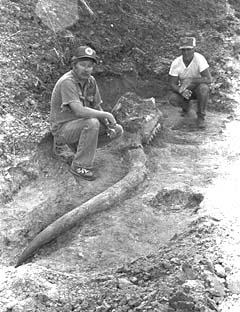 It’s time to reveal the answer to Monday’s Mystery Fossil. We had three people who correctly identified this as the skull of Mammut americanum, the American Mastodon.
Mastodon bones have been found throughout Arkansas, although almost all have been found either in northeast Arkansas between Crowley’s Ridge and the Mississippi River or along the Red River in Southwest Arkansas. According to the Arkansas State University Museum in Jonesboro, Arkansas has more mastodon finds than any other state in the mid-south region, with at least 20 different skeletons. Most of the work on them has been done by Dr. Frank Schambach and others of the Arkansas Archaeological Survey, headquartered at the University of Arkansas at Fayetteville, along with members of the Arkansas State University Museum. This particular mastodon was excavated by Dr. Schambach with the help of the Arkansas Archaeological Society along the Red River in Southwest Arkansas, I think in 1987, although I am not sure of the date yet.
Mastodons were related to elephants, although not as closely related to modern elephants as mammoths. Mammoths have also been found in Arkansas, most notably the Hazen mammoth, found in 1965. That specimen was a Columbian mammoth (Mammuthus columbi), a less hairy version of the wooly mammoth (Mammuthus primigenius). They lived across much of North and Central America during the Miocene and Pliocene, although they are known mostly from the Pleistocene in Arkansas, the heyday of the Ice Age, which is when people traditionally think of them living. They were similar in size to modern elephants.
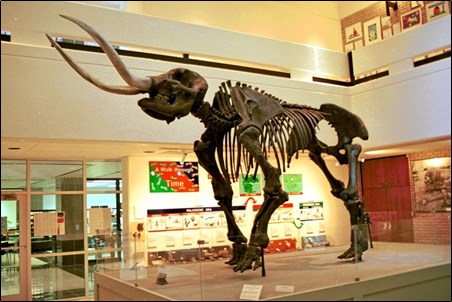
Mastodon, Arkansas State University Museum
The teeth of mastodons, mammoths and modern elephants tell an interesting story. Modern elephants have a wide diet of vegetation from grass to fruit and tree limbs. The Asian elephant has teeth that are more plate-like in form, making a series of ridges that create an excellent grinding surface. African elephants spend more time in forests and bush lands, with a corresponding higher amount of bushy vegetation in their diet. Their teeth are large, multi-rooted teeth with a series of ridge-like cusps. Mammoths take the plate-like grinding surface to an extreme as an adaptation to the grasslands they frequented. Mastodons, on the other hand, specialized in the opposite direction, with large, prominent cusps suited to a more forested environment and diet. Thus, mastodons and mammoths formed a bracket surrounding elephant ecology.
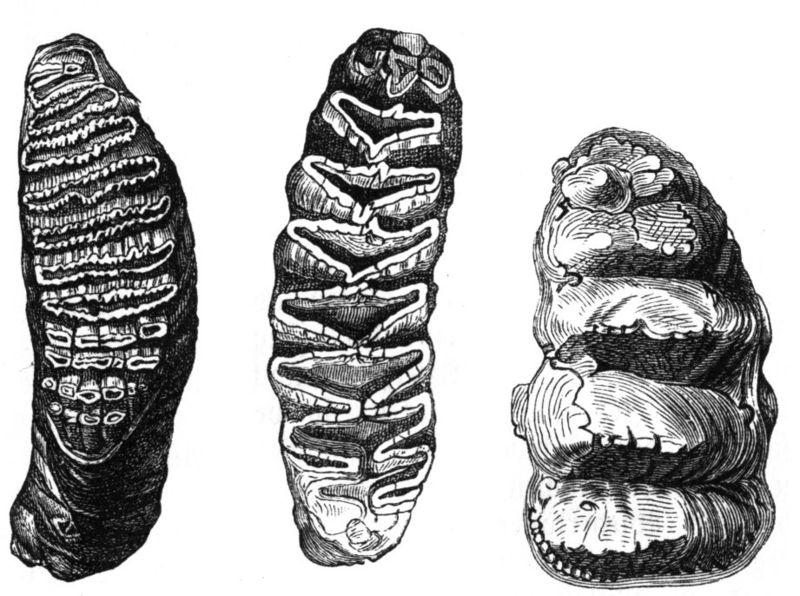
Asian Elephant (Elephas), AFrican Elephant (Loxodonta), Mastodon (Mammut). Wikimedia
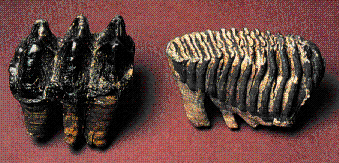
Mastodon (left), Mammoth (right). http://www.igsb.uiowa.edu/
Work that has recently come out has shed new light on why they went extinct. People have long argued over whether climate change or humans wiped out the megaherbivores at the end of the last ice age. The Overkill hypothesis postulated that early humans hunted them to extinction. There is also the alternative that other actions by early humans contributed to their extinction. However, while there has been plenty of evidence indicating humans did hunt mammoths (e.g. the Clovis people at the Dent site in Colorado), the hypothesis has come under fire for the lack of widespread hunting evidence and timing issues, with research indicating the megaherbivores were already going extinct before humans appeared on the scene. The other hypothesis, climate change, has gotten more support from a study of plant fossils. According to the new data, the early tundra environments were dominated, not by grass, but by forbs, weedy herbaceous plants with more nutrients than grasses. An earlier glaciation 20-25,000 years ago dramatically reduced the abundance of these plants. When the weather warmed up, the forbs increased again, but never approached their previous levels. When the next glaciation hit, the forbs mostly died out, allowing the less nutritious grasses to take over, which greatly reduced the amount of herbivores the land could support. Of course, this does not mean that humans had nothing to do with the extinctions, but it does mean they were likely not the primary cause, more likely simply throwing the last spear into the coffin of the great herbivores.
That’s it for this week. Check back Monday for a new mystery fossil. Have a good weekend.
Mystery Monday Fossil of the Week
Our Mystery Monday fossil concerns a photo taken by the Arkansas Archaeological Society on one of their digs. I’m still trying to find when this was taken, but I know roughly where. Can you tell what it is they are uncovering?
Fossil Friday
On Monday I posted a picture of a tooth from an animal that is a famous California resident, although is not generally considered an Arkansan. Were you able to figure it out?
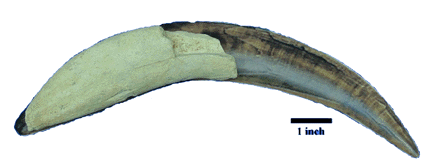
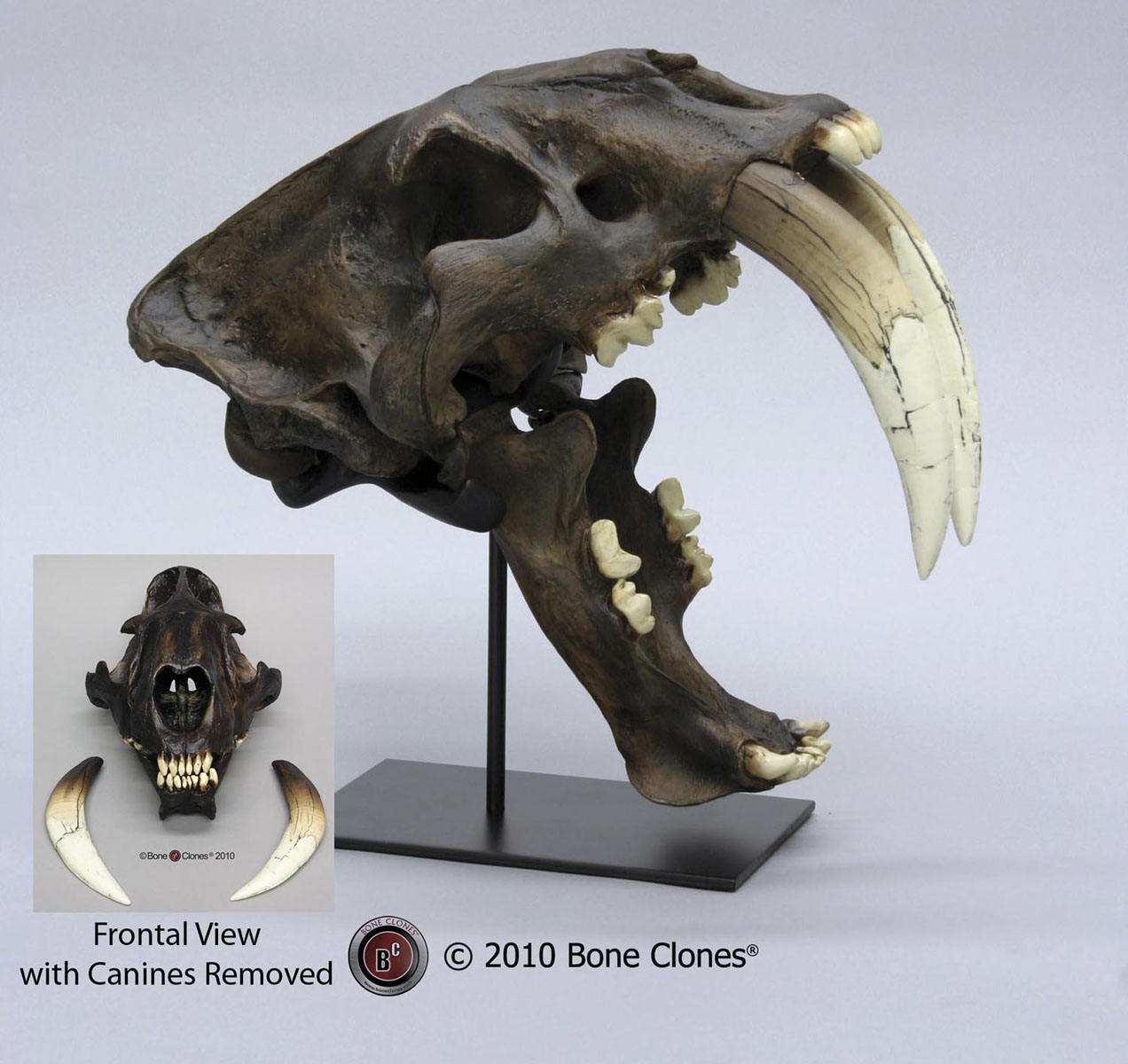 The tooth is a canine from a Smilodon, the saber-toothed tiger (although not actually related to tigers). Smilodon fossils have been found in a few caves in the Ozarks of northern Arkansas, most notably Hurricane River Cave and the Conard Fissure (the Conard Fissure was excavated by Barnum Brown for the American Museum of Natural History, who also did a lot of famous dinosaur digs for them in the Rockies) . Originally, they were described as having come from two different species of Smilodon: S. fatalis and S. floridensis. Smilodon fatalis, sometimes called S. californicus, is well-known from the La Brea Tar Pits in California, although has been found throughout much of North America and Pacific coastal areas of South America. Smilodon floridensis was known primarily from, unsurprisingly, Florida and neighboring states. However, these days most researchers view them all as the same species, so just Smilodon fatalis. There are two other recognized species. Smilodon populator lived in South America and was bigger, with a few hundred more pounds on S. fatalis. Smilodon gracilis was half the size of S. fatalis and lived earlier than either of the other species, and is considered by some to be ancestral to them.
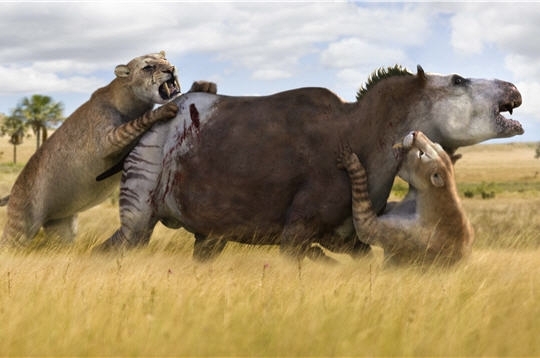
prehistoricpark.wikia.com
Smilodon fatalis is the quintessential Ice Age predator. It appeared about 2.5 million years ago and only died out about 10-13,000 years ago, so it may have been possible that Smilodon preyed upon early humans, at least along the Pacific coastal areas. It was a big, burly cat weighing up to 600 lbs. with heavily muscled forelimbs. Of course, it is best-known for its 7” long, serrated canines, thus the name Smilodon, meaning “carving knife tooth”. Smilodons were part of a group known as Machairodontinae, a subfamily within Felidae known as the “dirk-toothed cats.” These long teeth necessitated a jaw that could swing extraordinarily wide. Smilodon was specialized for killing large prey, such as bison, horses, and young mammoths and mastodons. Much debate has centered on how it dispatched its prey, with depictions of a Smilodon burying its canines in the skull or eviscerating its prey. However, more recent studies have indicated the canines were too fragile to withstand such treatment or couldn’t get a sufficient bite to properly tear into the abdomen. It is thought instead that Smilodon used its powerful forelimbs to stun and restrain the prey until it could bring its canines into play with its powerful neck muscles to slash the throat and cut the major arteries, causing the animal to bleed out quickly. They were not fast runners, preferring to attack from ambush, staying hidden within the vegetation of the forests and bushlands it preferred to live in.
Youngsteadt J.O., 1980: A saber toothed cat smilodon floridanus from hurricane river cave northwest arkansas usa. Nss Bulletin: 8-14
B. Brown, The Conard Fissure, A Pleistocene Bone Deposit in Northern Arkansas…,Memoirs of the American Museum of Natural History, Vol IX, Part IV, February 1908.
Mystery Monday

Today we have a picture by Ronny Thomas of a very well-known animal, although it is quite rare in Arkansas. In fact, only one has ever been found in the state. So what do you think it is? Stay tuned for the answer on Friday.
Fossil, and Forum, Friday
I’m sorry, but I forgot to post the Mystery Monday fossil on the blog. I posted the fossil on the Facebook page, but somehow failed to get it posted here, for which I apologize. Here is the fossil I posted, including the identifying portion cropped from the original picture. This image was taken from trilobites.info, a great website for all things trilobite.

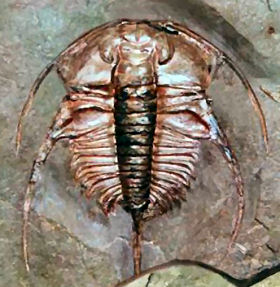
Here is Bristolia for comparison. This image is also from trilobites.info
It was correctly identified as a trilobite, although this one is the species Irvingella, not Bristolia as was guessed. Irvingella is very similar, but lacks the tail spine and the second set of spines is a little farther down the body. They are both listed as “fast-moving low-level epifaunal” feeders by the Paleobiology Database, which means they scurried quickly about over the ocean floor. But whereas Bristolia is thought to have been a deposit feeder, much like a crawfish, Irvingella was a carnivore, preying on worms, bugs, and such. They both lived in offshore marine environments, but whereas Bristolia has been found mostly in shallower waters, Irvingella has been found widespread from offshore throughout the continental shelf and even deeper water. This may have more to do with Bristolia having only been found in a few places in the southwestern United States while Irvingella has a much broader range throughout much of North America and Asia. They both lived in the Cambrian Period, although Bristolia seems to have lived a little earlier than Irvingella (there are some discrepancies in the published records making it difficult to compare exactly, this is partly due to revisions of the time scale and refinements in age estimates over the decades making detailed comparisons problematic).
Since our last Forum Friday recap, we have started a new year. We have reviewed the Walking with Dinosaurs movie. We identified an Exogyra ponderosa oyster, Archimedes bryozoan, Aetobatus eagle ray, and this Irvingella trilobite.
Over on the Facebook page so far this year, we have seen some amazing animals, including sharks that glow in the dark, a fish that walks on land, and a caterpillar who’s tobacco breath repulses spiders. We even learned why sharks don’t make bone, but polygamous mice have big penis bones and an organism that changes its genetic structure seasonally.

A green biofluorescent chain catshark (Scyliorhinus retifer). Livescience.com. Credit: ©J. Sparks, D. Gruber, and V. Pieribone
We saw two articles on fighting dinosaurs. We learned how they took over the planet and discussed scaly dinosaurs for a change. We found out some ancient marine reptiles were black and Tiktaalik had legs.
A lot of articles hit the press on human evolution in 2013. We also found out (some) humans developed the ability to tolerate lactose to not starve and how we smell sickness in others. We also found a great book on Evolution & Medicine. We also saw evidence of how our actions affect the evolution of other animals and someone who thinks they can understand dog language.
We read that plants may have caused the Devonian extinction event, a genetic study saying placental mammals originated before the end-Cretaceous extinction event despite no fossils ever having been found, and that small mammals with flexible schedules handle climate change better than big mammals that keep a stricter schedule.
We found a great , concise explanation of evolution and three different short videos on the history of life on earth, two of them animated and set to music. We also heard Neal DeGrasse Tyson urge more scientists to do more science outreach (and how to cook a pizza in 3 seconds). Unfortunately, we also heard about the deplorable conditions during filming on Animal Planet and creationism in Texas public schools, as well as how the failure to take evolution into account can screw up conservation efforts.
So what did you like? Did you guess the fossil? Is there anything you want to see? Let us know.
Fossil Friday
Another week has gone by and so little done here. I started my Vertebrate paleontology class this week and if you think it takes a lot of work to take one, just imagine the amount of time it takes to design one.
So today, we announce the mystery fossil from Monday. Did you have any idea what it was? It stumped everyone on the Facebook page, so if you couldn’t figure it out, don’t feel bad. It was a hard one. These are not terribly uncommon fossils, but most people are completely unfamiliar with them, despite the fact that anyone who visits a public aquarium has seen its living relatives.
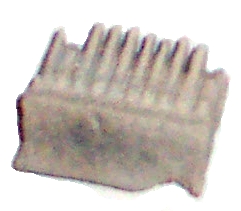
This is part of a tooth plate from a ray, most likely Aetobatus, the eagle ray. They are filter feeders eating plankton and have been around since the Miocene 20 million years ago. While none have been found in Arkansas that I know of, they have been found in pretty much every state around us, so I expect so collector out there somewhere has probably found some here. Check us out Monday for a new fossil!
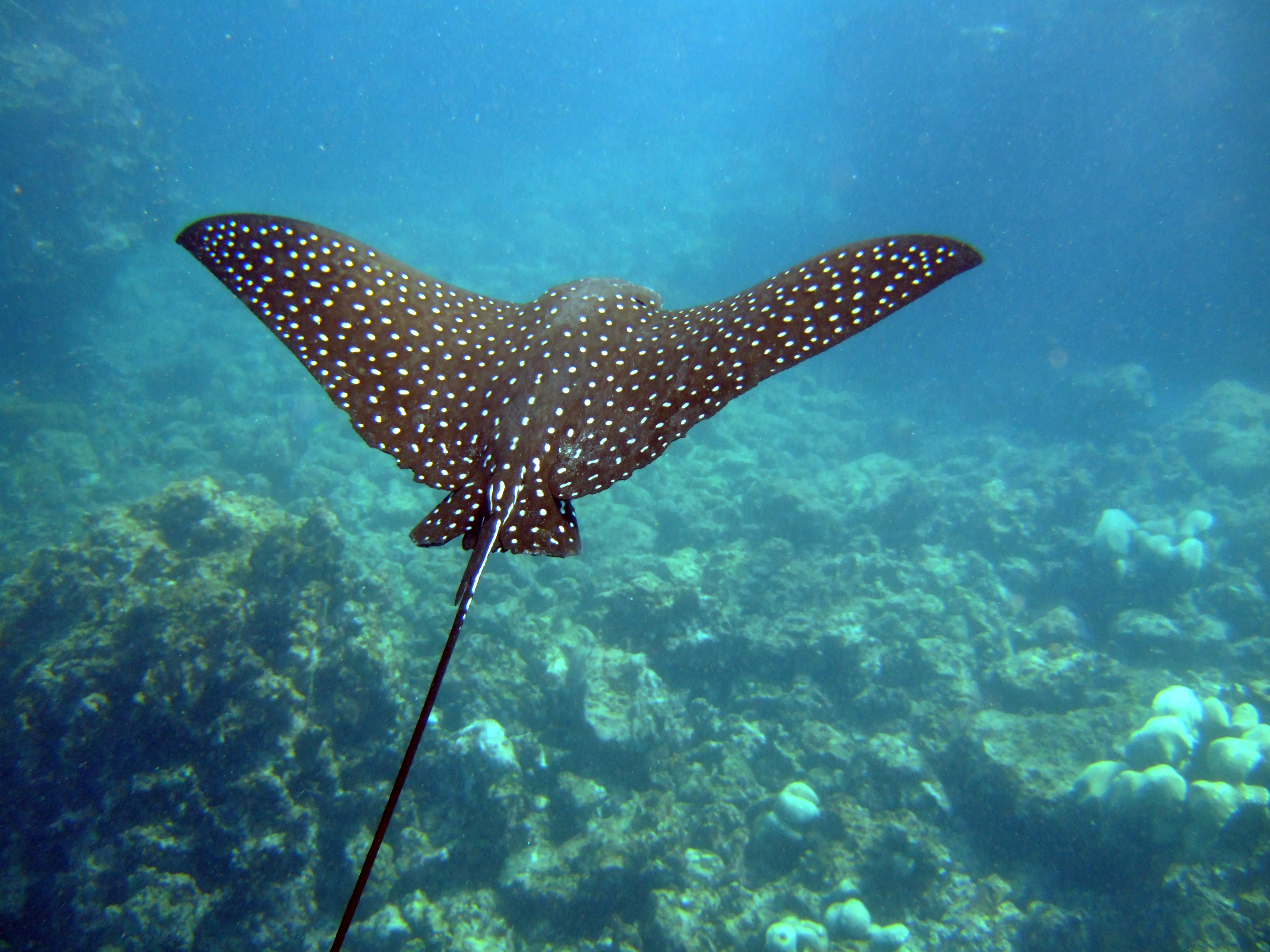
Spotted_Eagle_Ray_(Aetobatus_narinari). Wikipedia.
UPDATE: I need to correct a mistake I made in this post. Eagle rays, like Aetobatis here, were and are not filter feeders. The large rays, like the Manta ray in the same family, are indeed filter feeders, the smaller rays, like Aetobatus and its close relative Myliobatis, another ray that lived in the area at the same time (as well as earlier in the Eocene over 40 million years ago), were durophagous, meaning they used their teeth to crush shelled prey, such as clams, crabs, and shrimp. The main part of the tooth brought to bear on the prey item is the flat, plate-like part.
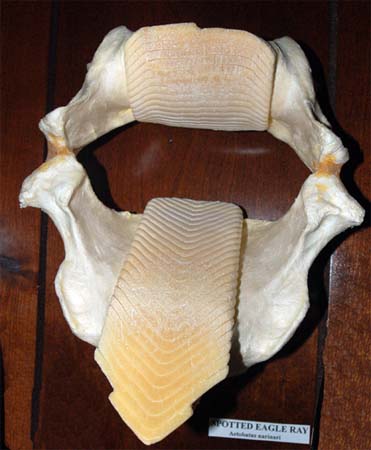 For this picture and much more information on the current species of eagle rays, go to the Florida Museum of Natural History.
Fossil Friday
It has been a strange week, what with trying to catch up from the holidays and all. So this post will be brief. On Monday, I posted this picture of a commonly found fossil in Arkansas, provided you look in the right places. Here were the clues.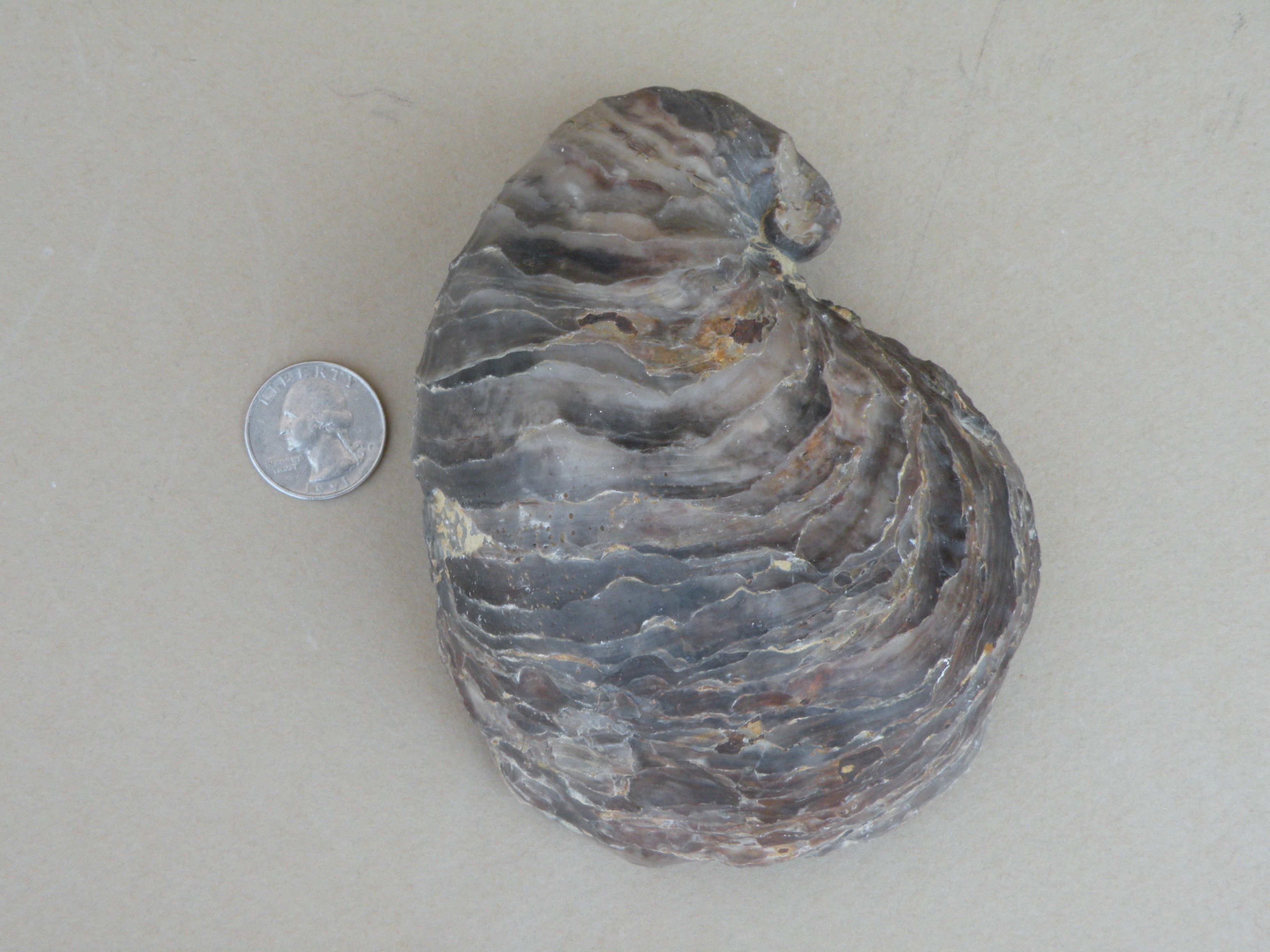
Clue 1: It’s from the Cretaceous.
Clue 2: It’s modern day relatives are widely considered a delicacy.
Clue 3: This is no wilting lily. This creature is big and bold. It shows how twisted it is on the outside for all the world to see. Dude, that’s heavy.
Were you able to figure it out?
So for the final reveal: Exogyra ponderosa. Allie Valtakis was able to figure out it was a mollusc, specifically a bivalve (clam), in the Order Ostreoida, Family Gryphaeidae. While mosasaurs swam the oceans and dinosaurs walked the shores, these Late Cretaceous oysters made huge oyster beds throughout the coastal waters. Like all oysters, they were filter-feeders, collecting microscopic particles of food from the water. You can find them in south-central Arkansas within several rock units, but most particularly in the Marlbrook Marl, a limy mudstone. They are known for their large, heavy, rough bottom shell with a curled, hornlike part near the hinge. The top shell is much smaller and flatter, but still a good size, something like a cap on a coffee cup, if your coffee cup was kind of bowl-shaped. They are sometimes called Devil’s toenails, but that name usually refers to a different clam called Gryphaea, an oyster that is also in the Family Gryphaeidae, but a different subfamily. If you look under a microscope at the shell, you may notice that it is very porous, giving the Family the nickname of foam or honeycomb oysters. Some are still alive today, such as Hyotissa hyotis, the giant honeycomb oyster
E. ponderosa was one of the earliest clams of this genus that was named, by Ferdinand Roemer in 1852, a German lawyer who gave up law to study geology in Texas, thus his title as the Father of the Geology of Texas. You can fossils of them from Texas to New Jersey and Delaware, south through Mexico and Peru.
Until next time, as Dr. Scott The Paleontologist would say, ‘Get out there, get into nature, and make your own discoveries.”
Happy New Year! Welcome to 2014
 Welcome back! I hope everyone had a great holiday to mark the end of a great year. 2013 marked the inaugural year for Paleoaerie. Version 1 of the website was set up, providing links to a wealth of online resources on fossils, evolution, the challenges of teaching evolution and the techniques to do it well. The blog had 26 posts, in which we reviewed several books and websites, discussed Cambrian rocks in Arkansas and the dinosaur “Arkansaurus,” and went to the annual meeting of the Society of Vertebrate Paleontology. We looked at geologic time and started a series on dinosaur misconceptions. We also had several Forum Fridays, recapping the many news stories reported on the Facebook page. One of the recent things we’ve started is Mystery Monday, posting a fossil of the week for people to try to identify. Speaking of which, to start off the new year, the first mystery fossil will be posted early. look for it at the end of this post.
In the upcoming year, we hope to expand the site, providing many more resources, along with continuing posts on Arkansas geology and fossils, including many more mystery fossils. Stick with us and you will learn about the history of Arkansas in a way that few people know. The site will be revamped to be more user-friendly and enticing to visitors. If plans materialize, we will be adding interactive activities, animations, and videos, many of which will be created by users of the site. Materials from workshops and talks will be posted for people to view and use. More scientists will be posted that have offered their services to teachers and students. We encourage you to contact them. They are there as a resource.
Of course, all of this does not come free. it takes money to provide quality services. Thus, more avenues of funding will be pursued, including other grant opportunities and likely a Kickstarter proposal. You may soon see a small button on the side of the website for Paypal donations. Any money donated will go first towards site maintenance. Other funds will go towards a student award for website design, a 3D laser scanner to put fully interactive 3D fossil images on the site, and materials for review and teacher workshops. If grant funding becomes available, additional money will be spent on research into the effectiveness and reach of the project. But even if no more funding becomes available, you can still look forward to continuing essays on Arkansas fossils, reviews of good books and websites, and curation of online resources suitable for teachers, students, and anyone else interested in learning about the endlessly fascinating history of life on planet earth.
I mentioned at the beginning about the latest mystery fossil. Here’s the first hint: it is a very common fossil found in Arkansas and lived during the Mississippian period roughly 330 million years ago. More hints and photos to come. Leave your guesses in the comments section. Don’t worry about getting it wrong, every success has lots of failures behind it. Errors are only stepping stones to knowledge.
Clue number 2: Many people think I’m a coral, but I’m not.
Clue number 3: I am named after a famous Greek mathematician and inventor.
What am I?
Forum Fridays and Mystery Mondays
Likely thanks to upgrading computer systems and the joys of trying to figure out new setups and operating systems, there seems to have been a small glitch deleting the post that was supposed to go up Friday, so it is getting posted today. So let’s see if we can make lemonade from the lemon.
On Facebook, I started a new set of posts, in which I post a picture of a fossil found in or could be found in Arkansas and see if anyone can identify it. The first one I put up was of a mosasaur, a huge aquatic reptile that swam around Arkansas seas during the Cretaceous Period. People seemed to enjoy it, so I will be doing this on a regular basis. However, it has come to my attention that many places block Facebook, including a lot of schools. So I will be posting them on the blog. I will try to post a new picture every Monday and will then provide the answer on Friday, giving people the week to see if they can come up with the answer. Don’t worry about being wrong, we learn more from our failures than our successes anyway. You can’t win if you don’t play. So with that, let’s play! here is today’s pic. Can you tell me what it is?

In the meantime, if you missed out on all the stuff we covered on Facebook, here is a brief summary of most of hte stories.
Of the many new fossils and work on fossils that were reported on this month, we saw a new fossil primate that may have been ancestral to lemurs and lorises and giant, terrestrial pterosaurs of doom. We learned about the earliest flowering plant in north America, new crests for old dinosaurs and the promise and perils of resurrecting dinosaurs and other extinct animals..
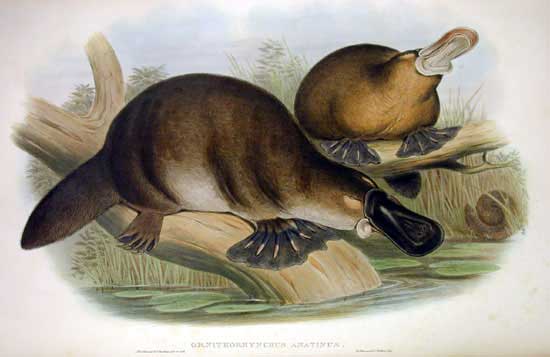
The poor platypus, he has no stomach (but at least he has poison spurs). John Gould. 1863. Wikimedia.
We learned about evolutionary ghosts, how animals colonize new territory, and how unmasking latent variation within a population can lead to rapid evolution.
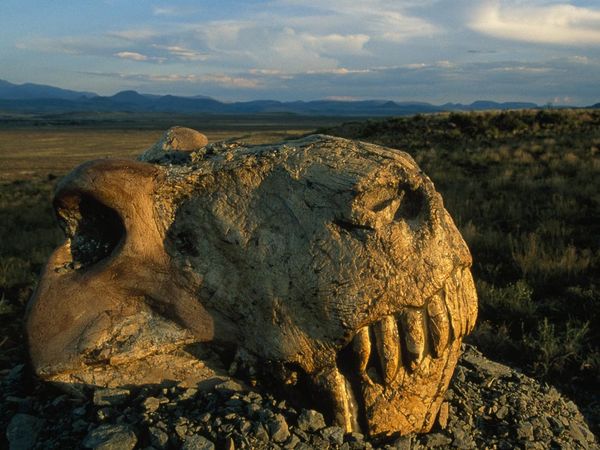
Photo by Jonathan Blair. http://tinyurl.com/n4xzv26
We learned how evolution made it easier for people to believe in God than accept evolution and why fanaticism of any stripe can lead one astray. We read a discussion about the importance of scientists in science communication, and why we shouldn’t ignore Youtube. We found help in teaching controversial subjects in hostile environments and apps to help teach hard-to-grasp subjects like astronomical distance.
We learned about how bacteria avoid the immune system to cause disease, how they form an important part of breast milk, and the four billion year history of vitamins. We learned even bacteria have a hard time living deep inside the earth and how viruses can kill even antibiotic-resistant bacteria. We also read a review of a book on evolutionary medicine.
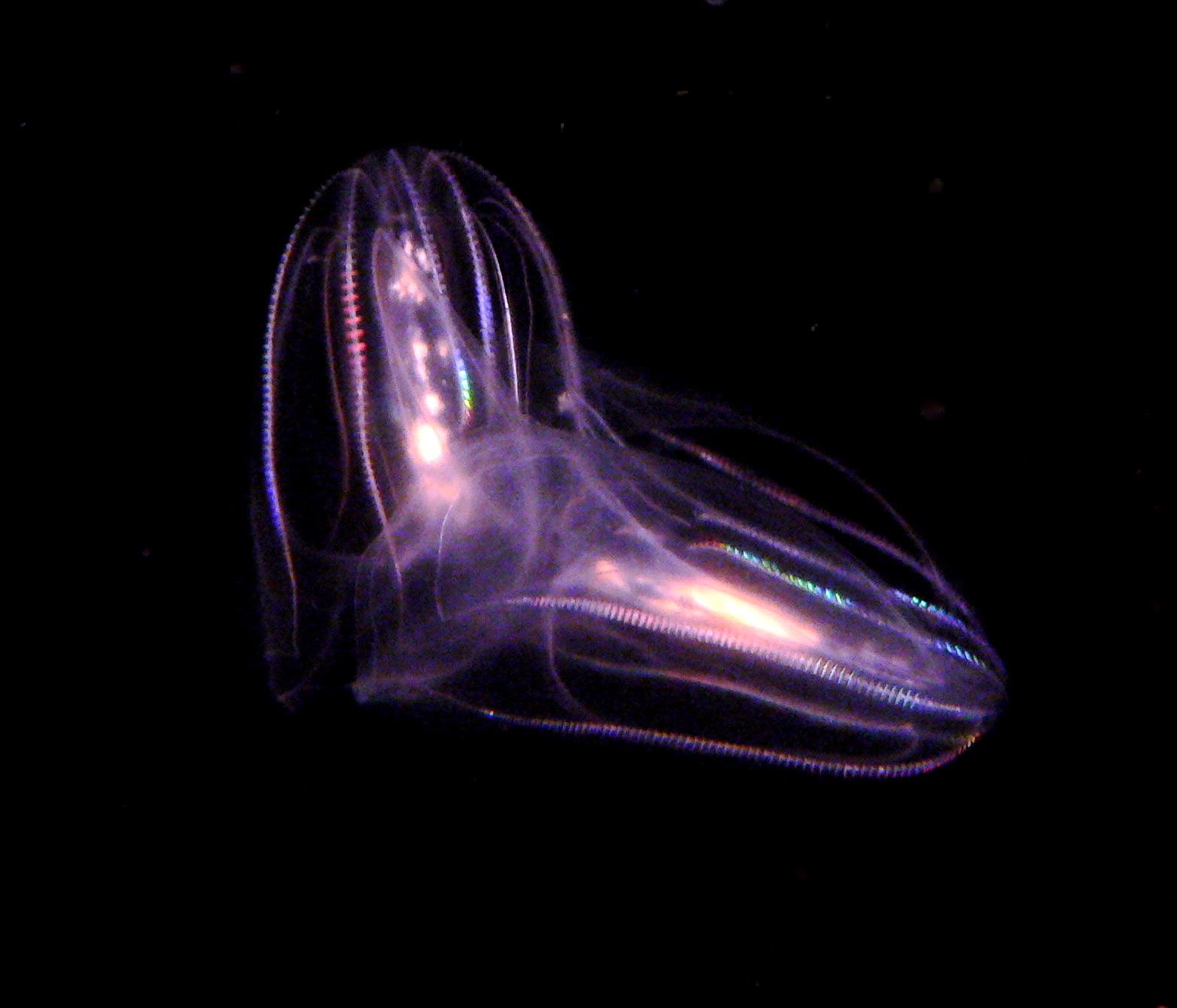
Comb jelly. Wikimedia. Creative Commons Attribution 2.0 generic license.
So, what were the stories you liked? Did it spark any thoughts, either good or bad? Was there anything that you saw that we didn’t mention? Share your thoughts and don’t forget to try your luck with identifying today’s Arkansas fossil!
“Arkansaurus,” the only Arkansas Dinosaur
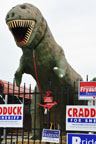
Welcome to the first of a series on Arkansas fossils. Arkansas is not generally known as a mecca for dinosaur lovers. Most of the dinosaurs in Arkansas are statues created by a man named Leo Cate, which have all the accuracy of the old plastic toys on which he based the statues, which is to say, not much (of course, he made them for enjoyment, not as anatomical models, so they serve their purpose). Nevertheless, dinosaurs are the first thing I get asked about when I give talks in schools, so I decided to start off with a discussion of our one and only dinosaur, called “Arkansaurus fridayi.”
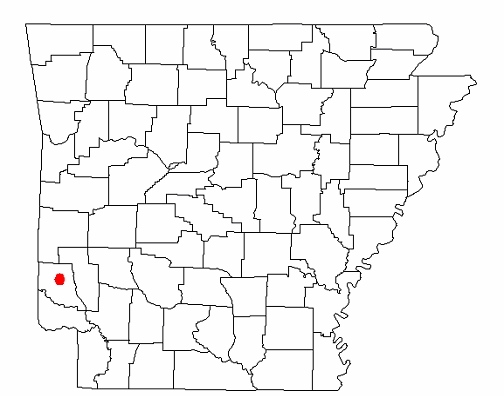 Ordinarily, I would not delve into how a fossil was found here, but because Arkansaurus is unique and illustrative of how many fossils are brought to the attention of science, a brief synopsis of the story of how it was brought to the attention of science may be of interest. In August, 1972, Joe Friday was searching for a lost cow on his property near Lockesburg in Sevier County, when he found some bones eroding out of a shallow gravel pit. He showed them to a Mr. Zachry, whose son, Doy, happened to be a student at the University of Arkansas in Fayetteville. Doy showed the bones to Dr. James H. Quinn, a professor at UA, who identified them as part of the foot of a theropod dinosaur. He contacted the Arkansas Geological Survey and Dr. Quinn, Ben Clardy of the AGS, and Mr. Zachry went back to the site where they found the rest of the bones. Dr. Quinn presented the bones at a meeting of the Society of Vertebrate Paleontology where he discussed the bones with Dr. Edwin Colbert, a noted paleontologist who was an expert in dinosaurs and vertebrate evolution. They came to the conclusion that the bones probably came from some type of ornithomimid, a group of ostrich-like dinosaurs (the name literally means bird-mimic), one of which, named Gallimimus, was made famous in Jurassic Park. Despite further excavations, no additional bones have been found. Dr. Quinn never officially described the bones, publishing only an abstract for a regional meeting of the Geological Society of America in 1973. It remained for Rebecca Hunt-Foster, now a paleontologist for the Bureau of Land Management, to publish the official description 30 years later in the Proceedings Journal of the 2003 Arkansas Undergraduate Research Conference.
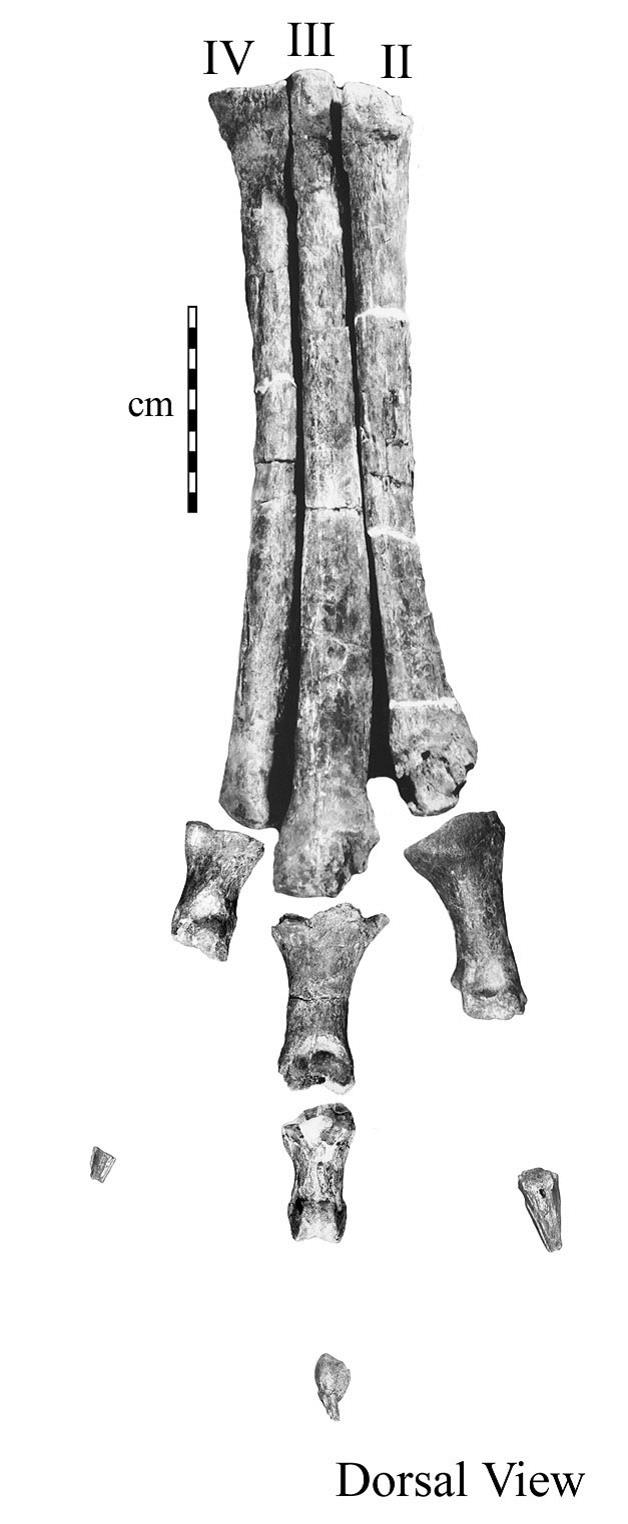
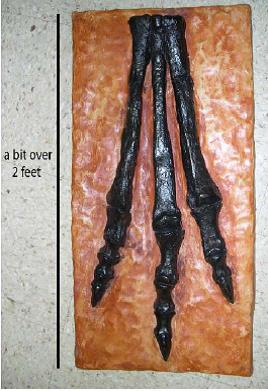
The first thing to know about this particular dinosaur is that “Arkansaurus fridayi” is not its real name. In fact, it doesn’t even have an official name. The reason for this is because all we have of it is part of one foot. Specifically, we have the metatarsals, a few phalangeal bones, and the unguals. In non-science speak, on humans, they would refer to the bones making up the front half of your foot. The metatarsals are the long bones the toes are attached to forming the front part of the arch, the phalanges are the toes, and the unguals are the bony cores of the claws. The pictures show the actual bones and a cast, in which the missing phalangeal bones have been restored. The real fossil has all the phalangeal bones connecting to the metatarsals and all the unguals, but a couple of the middle phalanges are missing. We have no ankle bones and nothing at all of the rest of the animal. With such little to go on, it has been difficult to determine exactly what kind of dinosaur it is, so no scientist has been comfortable giving it an official name yet. To add to the complications, not a whole lot of feet from theropod dinosaurs are known, so good comparison material is limited, and little is known about theropods in the southern United States to begin with. (Aside: dinosaurs are separated into two groups. The Ornithischia, which are comprised of the herbivorous, mostly four-footed dinosaurs; and the Saurischia, which include the giant, long-necked sauropods and the bipedal, mostly carnivorous theropods.)
So why only one foot? What happened to the rest of it? I’ll let Rebecca Hunt-Foster explain it, as she did an excellent job: “There are several possibilities that would explain the occurrence of a single foot at the Friday site. It is a possibility that the rest of the Friday specimen could be gravel on highway 24. Road crews could have cut into the Trinity Group (Ed. Note. The rock formation in which the bones were found) when excavating the Quaternary gravel that lies directly above it, when building the road in 1954. As another theory, the animal may have begun to decompose before its body was carried by water to the site of deposition. Consequentlly, bits and pieces could have been scavenged by predators in the Lower Cretaceous, resulting in only a single foot remaining for preservation. Finally, it is possible that the entire specimen was preserved but that most of the skeleton was lost to Pleistocene erosion.” So just think about that the next time you go driving down the road. What fossils might you be driving upon?
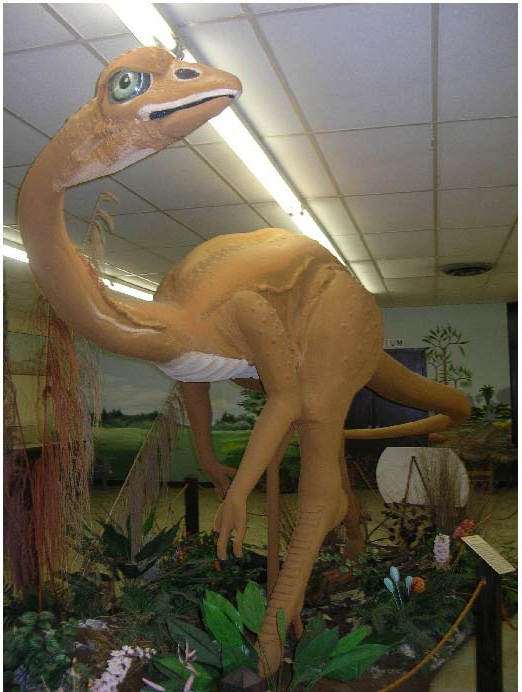 Even if we don’t know for sure what it is, we do have some clues and can narrow down, at least a little, what it might be. What we know for sure is that it is some kind of coelurosaur. That, unfortunately, doesn’t help us a lot because coelurosaurs cover everything from little compsognathids to giant tyrannosaurs to modern birds, known principally for having bigger brains than earlier theropods, slender feet with three toes, and many of them had feathers. It does tell us it is not closely related to dinosaurs like allosaurs and spinosaurs, nor to early theropods like ceratosaurs and Coelophysis. Dr. James Kirkland opined that it was similar to Nedcolbertia, a small coelurosaur found in Utah. The problem here is that no one knows much more about Nedcolbertia either and its relationships to other dinosaurs are unclear. Quinn and Colbert thought it may have been an ornithomimid, but closer inspection by Rebecca Hunt-Foster and comparison with known ornithomimids indicates this is unlikely. Right now, all that can really be said is that it is likely a small coelurosaur, but not a tyrannosaurid, ornithomimid, or advanced form more closely related to birds, which leaves a small group of poorly known coelurosaurs no one really knows what to do with.
Using these animals as a comparison, what can we say about what kind of animal “Arkansaurus” was? It was likely a fast runner with probably an omnivorous diet, eating smaller animals and supplementing its diet with plants. It would likely have stood somewhere between 2-4 meters (6.5-13 feet) tall. It would have looked something like an ostrich with long arms ending in hands with three functional fingers, with one of them being at least semi-opposable, and a jaw filled with small teeth. If it had feathers (which seems increasingly likely), the feathers would have looked more like fur than the large feathery plumage seen on ostriches today. It would also have had large eyes like ostriches, with excellent color vision, based on the fact that its nearest living relatives, crocodilians and birds, all see a broad spectrum of colors (even better than humans).
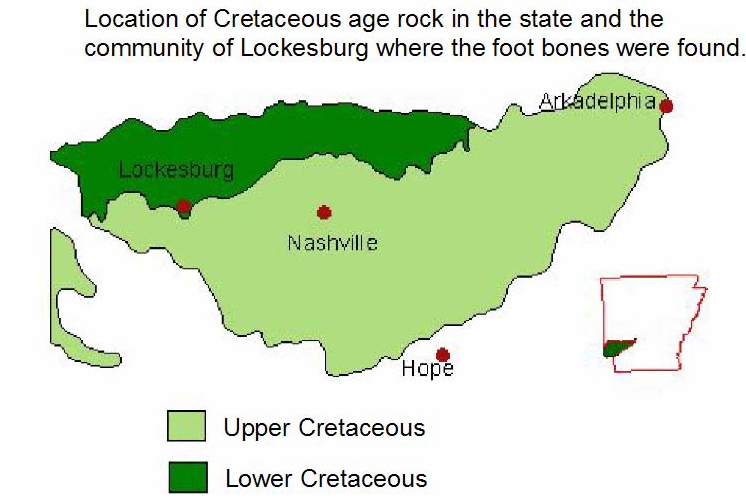 The rocks the bones were found in were part of what is called the Trinity Group. These rock layers (or strata) consist of layers of sand, clay, gravel, limestone, and gypsum laid down in the Early Cretaceous Period, roughly around 100-120 million years ago (what is known as the Albian and Aptian Ages). The rocks indicate that during the time the rocks were formed, the environment was a shallow marine coastal area not unlike south Texas near the Rio Grande or in the Persian Gulf. Our dinosaur would certainly not have been alone. There were other dinosaurs in the vicinity, we just know very little about them. Sauropods left thousands of tracks in the coastal sediment forming a massive trackway found in a Howard Country gypsum mine in 1983. Another trackway found in 2011 has tracks from sauropods such as Pleurocoelus and Paluxysaurus (which may or may not refer to the same species and may or may not also be called Sauroposeidon) as well as tracks from what was probably the giant theropod Acrocanthosaurus.
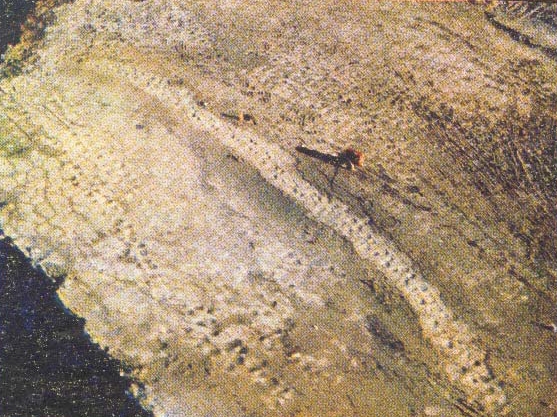
Howard County trackway.
Most of the information and images in this post not directly linked to came from the following sources. Many thanks to Rebecca Hunt-Foster for clean pictures from her paper, which she also graciously supplied.
Hunt, ReBecca K., Daniel Chure, and Leo Carson Davis. “An Early Cretaceous Theropod Foot from Southwestern Arkansas.”Proceedings Journal of the Arkansas Undergraduate Research Conference 10 (2003): 87–103.
Braden, Angela K. The Arkansas Dinosaur “Arkansaurus fridayi”. Little Rock: Arkansas Geological Commission, 1998.
The top image is a Leo Cate T. rex. Photo by Debra Jane Seltzer, RoadsideArchitecture.com.
UPDATE: Arkansaurus has recently been named the Arkansas official state dinosaur, reviving interest in the fossil. It is currently being re-examined by Dr. Rebecca Hunt-Foster, with the hopes that new fossils and information that has come to light since her last publication will provide a more refined determination of its relationships.

 paleoaerie