Fossil Friday, make it a Productive one
Were you able to solve Monday’s mystery fossil? They aren’t little poop balls, nor are they clams, although they are often mistaken for them.
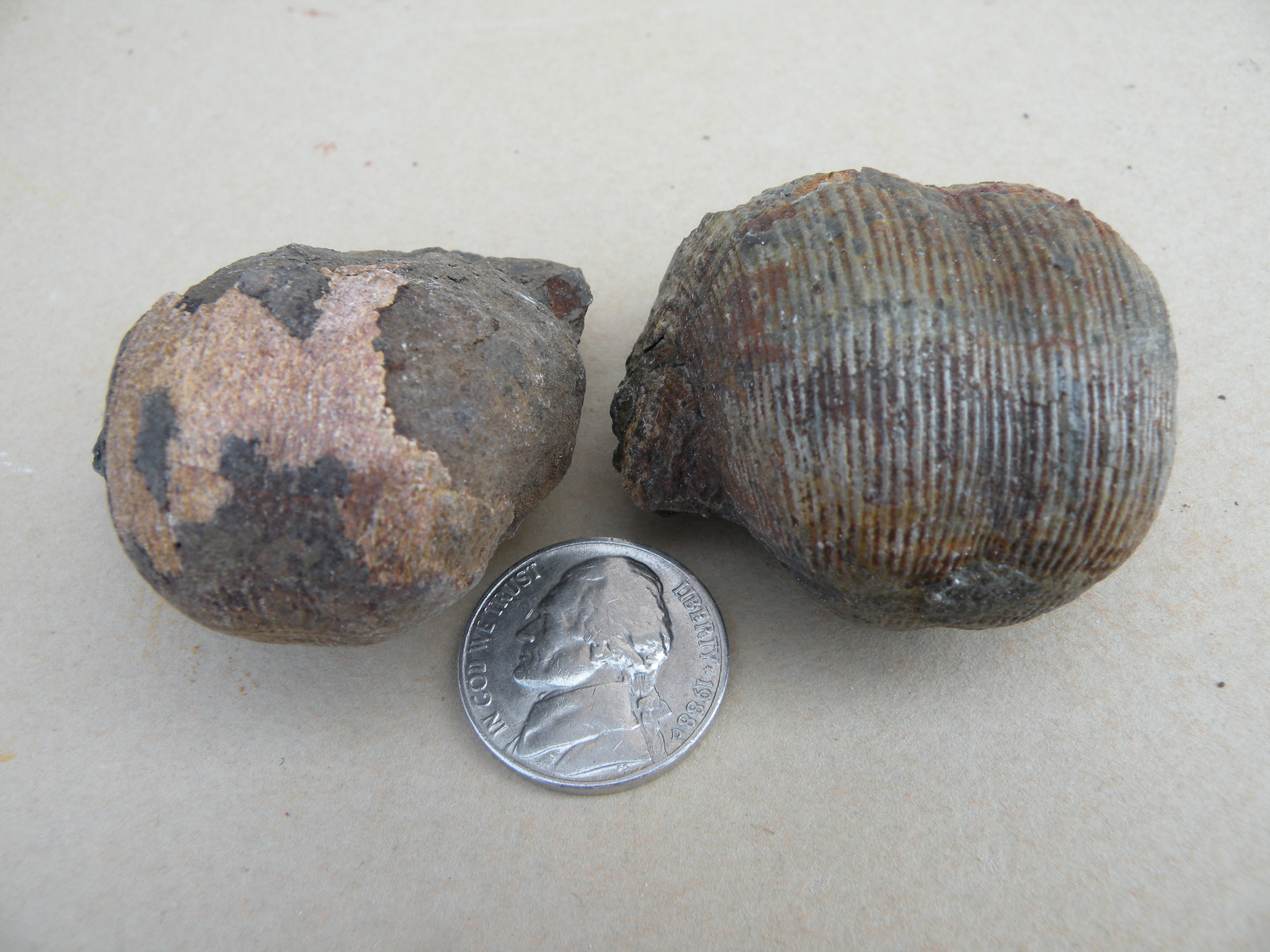
This photo can be found at the Arkansas Geological Survey website under “Brachiopod.” They look a lot like clams. Brachiopods, often called lamp shells, have two shells and live in shallow marine environments just like clams and the occupy the same niche, feeding on organics filtered from the water. But unlike clams, which are molluscs, just like snails and squid, brachiopods are lophophorates, most closely related to bryozoans, the “moss animals.”.
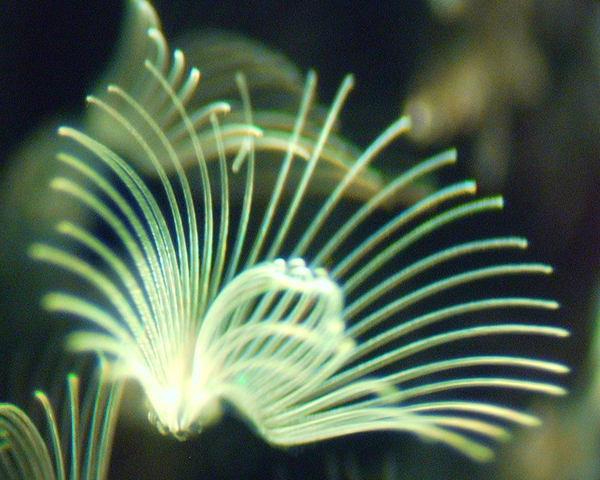
Bryozoan lophophore. http://www.geol.umd.edu/
So what is a lophophorate? Lophophorate means “crest or tuft bearer, so named for their feeding apparatus called a lophophore, which is shaped like a roughly circular or semi-circular ring of tentacles. These tentacles lazily wave through the water passing through the lophophore, catching small particles of food suspended in the currents. Thus, everything in this group are what is known as suspension feeders. These lophophores serve not only to collect food, but for gas exchange as well. In addition, the animals are headless, with the lophophore surrounding the mouth. The food enters the mouth and passes through the digestive tract, which makes a U-turn and dumps out what it can’t digest just outside the ring of tentacles. Clams do essentially the same thing, only they use an entirely different apparatus to do so.
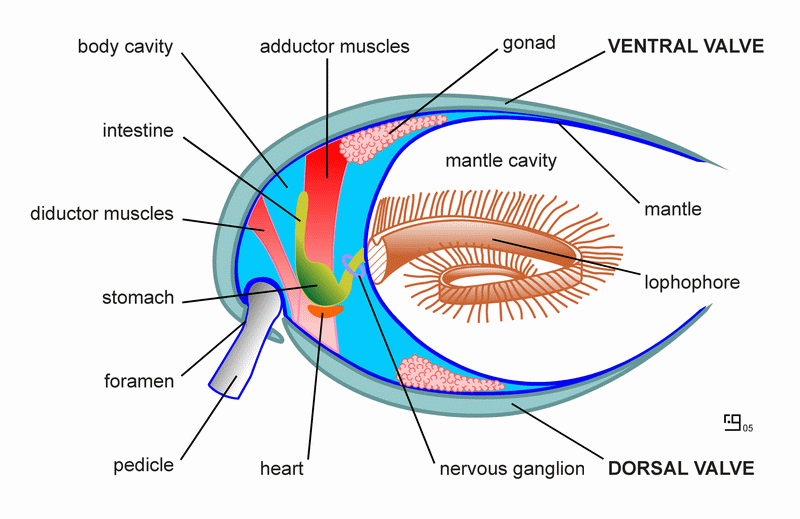
Clams attach themselves to surfaces by secreting a collection of what are called byssal threads. Most brachiopods, on the other hand, form a pedicle, a stalk that holds them in place. Some do not make pedicles, instead just gluing themselves down directly onto the rock.
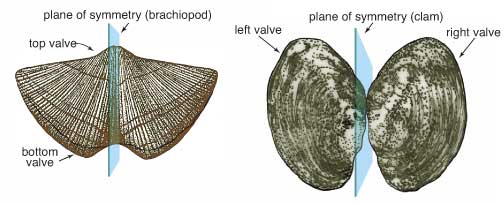
Symmetry in a brachiopod and clam. http://www.kgs.ku.edu
Another difference that can usually be seen between clams and brachiopods is the symmetry of their shells. Brachiopods are symmetrical from side to side, their left side is the same as their right side. Clams follow a different pattern. They usually have two identical shells, but the shells themselves are not symmetrical. This is not always true though. The Cretaceous oyster, Exogyra ponderosa, has an huge, thick shell on one side and a thin lid for a shell on the other. But as a general rule, this usually works. Another difference that is sometimes stated is that brachiopods use their muscles to close their shells, while clams use their muscles to open their shells, closing them by the use of ligaments; thus making brachiopods more susceptible to predators. This, however, is not true. In truth, brachiopods use their muscles to both open and close their shells. Clams have large adductor muscles that function to close the shells and they have ligaments that open them when the muscles relax.
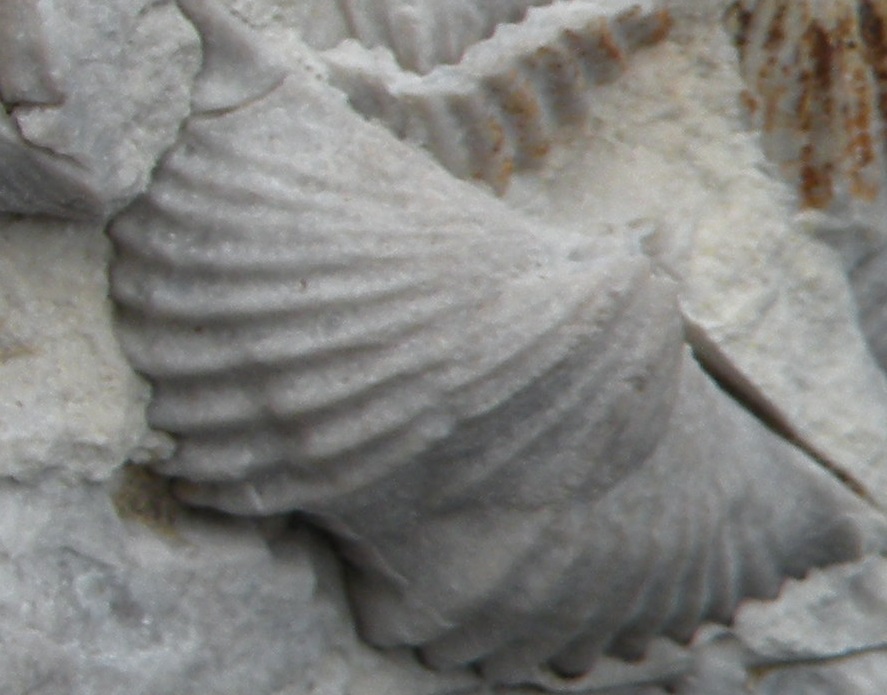 Brachiopods are quite diverse, with many different types. They range in size from less than a dime to almost 40 cm (15″). There are two general groups, the Articulates, which have toothed hinges holding the shells together, and the Inarticulates, which do not have teeth, so they fall apart easily after death. Probably the most commonly found in Arkansas are spirifers, known for being somewhat wing-shaped , with a prominent sulcus, or depression in the center. Many brachiopods prefer solid substrates, like rock, others were adapted for softer substrates like sand or mud.
 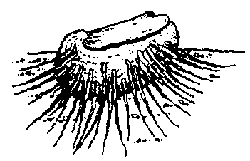 Productids, like the ones in our mystery fossil, often grew spines, which helped secure them to muddy surfaces. Others, like strophomenid brachiopods, handled muddy substrates by developing large, very flat shells, which floated on the mud like a snowshoe.
 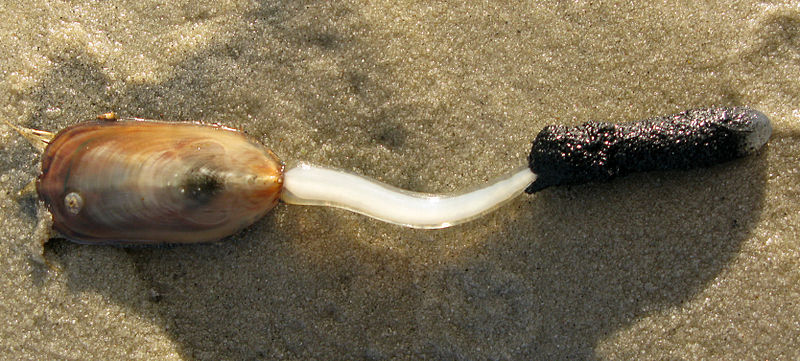 Still others, like the modern-day lingulids, developed long pedicles, allowing them to burrow down into the sediment.
Brachiopods have been around since at least the Cambrian, over 520 million years ago. They were most abundant in the Paleozoic Era, but suffered greatly during the Permo-triassic extinction event. They recovered to some extent, but never reached their previous abundance due to the appearance of clams, which began taking over some of the spaces they occupied. Nevertheless, there are still several different kinds in the modern ocean and can often be seen clinging to rocks near shore or buried in the sand. In Arkansas, you won’t find any living specimens, but you can find numerous fossil brachiopods in the Paleozoic rocks throughout the Ozarks and Boston Mountains, even in some places of the Arkansas Valley. Stop by any outcrop along Highway 65 between Conway and the north edge of the state, particularly limestone outcrops, and you are likely to find some. You can find a few in the Bigfork Chert in the Ouachitas, but they are not nearly so common as they are farther north.

Mystery Monday
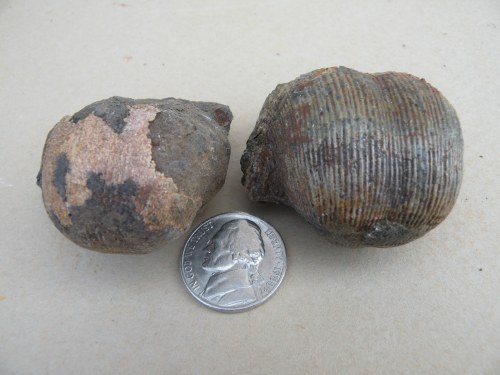
It’s Monday! Time for a new mystery fossil. See if you can guess what this is. Don’t clam up, put your guess in the comments below.
Fossil Friday, don’t be a wet blanket
Despite the snow, we didn’t get a chance to have any other posts this week other than the Monday Mystery fossil. We did, however, have three different school trips in the past couple of weeks to talk to kids about fossils, dinosaurs, and the skeletal system, as well as giving talks on the fossils telling us about the origins of crocodiles and dinosaurs, as well as attending a talk on the origins of birds. So a lot of paleo work, just not much showing up here. Fortunately, some of you had some time to examine our mystery fossil and congratulations to Laurenwritesscience for coming up with the correct answer.

It is indeed a stromatolite. Bruce Stinchcomb has a video on Youtube showing several examples of Ozark stromatolites and providing a good explanation of what they are.
Essentially, stromatolites are microbial ecosystems, built up of layer after layer of microbial mats. The general description is that of blue-green algae, which forms a sticky layer over the surface of a rocky surface in a shallow marine or coastal environment. Blue-green algae are not actually algae and are better referred to as cyanobacteria. These bacteria are photosynthetic, just like plants, so they need sunlight, thus limiting the depth at which they can be found. Actually, they are typically found right at the water’s edge in the tidal zone. This sticky substance, while maintaining their hold on the rock, also tends to collect sand, clay, and organic debris. Over time, all the stuff that sticks to the mat blocks the sunlight from the cyanobacteria and they migrate above the layer and build another mat, which collects more debris, which causes them to build another mat, etc. Stromatolites form much the same way as piles of laundry. By the time you finish washing one set, there is another pile forming in a neverending stream. The life of a cyanobacteria in a stromatolite is a depressing condition of always digging themselves out from under a pile just to get dumped on again. I am sure most people can empathize.
The sticky mucus (properly referred to as extrapolymeric substance, or EPS for short, but we can go with mucus here) forming the mat does more than just cause things to stick to it. The mat protects the bacteria in from ultraviolet radiation. It also allows the bacteria to control the microenvironment around them, keeping such things as pH levels in a good range. It also has an unfortunate aspect for the bacteria. The mucus allows the levels of calcium and carbonate ions to build up until they precipitate out of the water as calcium carbonate, also known as calcite (when referring to the mineral), or limestone (when referring to the rock). So not only are the poor bacteria constantly getting buried, they are getting turned to stone in their very own medusa nightmare. Life is hard as a cyanobacteria. But just wait, it gets worse.
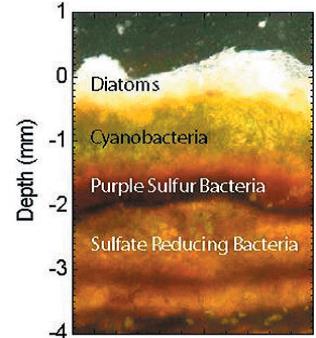 These microbial mats are not just cyanobacteria, though. There are lots of other organisms that live in and on them. There are many other types of bacteria. There are sulfate reducing bacteria, which use sulfur like we use oxygen, only they release hydrogen sulfide instead of carbon dioxide, causing a nice rotten egg smell. There are purple sulfur bacteria that eat the hydrogen sulfide, as well as colorless sulfur bacteria that eat both the hydrogen sulfide and the oxygen released by the cyanobacteria, thus free-loading off of everyone. In addition to bacteria, there are plenty of prokaryotes (organisms without nuclei that holds their DNA) and eukaryotic (with nuclei) single-celled and multi-celled organisms living in the mat. Diatoms, single-celled photosynthetic organisms that grow their own shell, live on top, while nematodes burrow through the mat. In addition to all this, a wide variety of animals love to chow down on the mats. Everything from snails, sea urchins, crabs, crawfish, and just regular old fish happily eat them. As a result, there are not a lot of places left in the world you can find stromatolites growing. The Bahamas and Shark’s Bay, Australia are the best areas to find them.
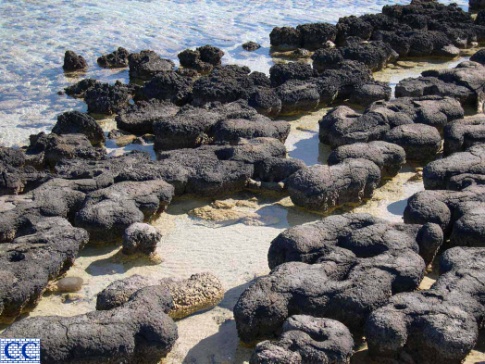 They may be rare now, but at one time, they ruled the earth. As some of the oldest living communities in the world, they have been around for at least 3.5 billion years (that’s 3,500,000,000, or roughly 600,000 times the length of human civilization) and for more 2/3 of that time, they were the only game in town and in all probability served as the cradle for all eukaryotic and multi-cellular organism on the planet. These days, if you live in Arkansas, the only places you can find them are as fossils in the Cambrian age Cotter Formation and Ordovician age Everton Formation in the Ozark Plateau.
For further information (and the source of the images shown here), check out the stromatolite page at the Arkansas Geological Survey and the Microbe Wiki stromatolite page, as well as the Microbes.arc.nasa.gov site, which supplies a nice teacher’s guide to teaching all about microbial mats, designed for grades 5-8.
Mystery Monday, another snow time edition
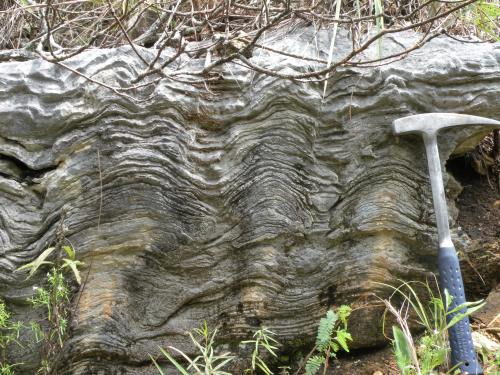
I don’t know where you may be, but where I am, ice is covering everything and all the schools are closed. It’s a great day to pull up the covers and stay under the blankets, maybe get a cup of hot chocolate and wait for warmer weather. That makes today’s Mystery Monday fossil particularly apropos. Yes, this really is a fossil, not just layers of sediment.
Fossil Friday! The Red-faced Fossil
Between classes and school appearances, I have not had the time to write up as complete a description as I would like, so I will do a more complete description of the fossil later. But for now, did any of you think you saw crinoids in the face? If you did, you are correct! This photo was originally published on the Arkansas Geological Survey‘s blog. If you haven’t checked them out, I encourage you to do so.
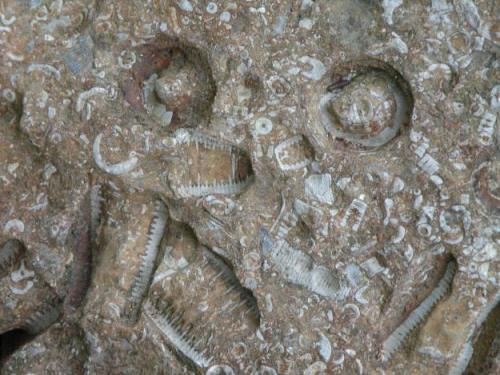
Crinoids are perhaps the most common fossil found in Arkansas. They can be found in many of the Paleozoic rocks in northern Arkansas in the Ozarks and Ouachitas, although they are most common in the Mississippian age limestones of the Ozarks. All those white rocks along Highway 65 towards Leslie and Marshall are good candidates, although watch out for cars along the highway, please.
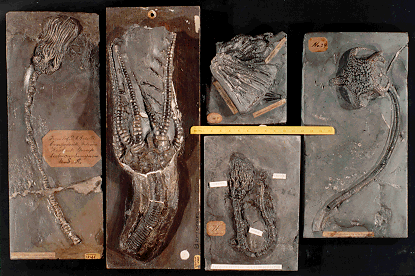
Stellar examples of crinoids in all their fossilized glory. This image and more information can be found at http://www.ucmp.berkeley.edu/echinodermata/crinoidea.html
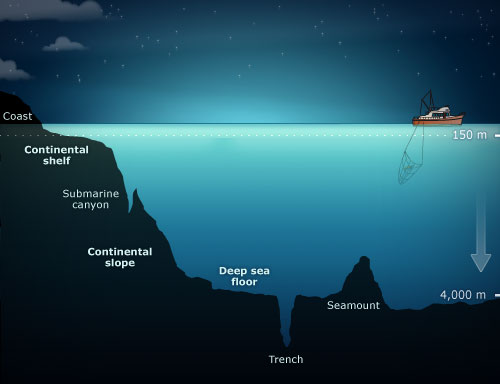
Crinoids are often called sea lilies because of their resemblance to plants, but they are actually animals that are related to sea urchins and starfish, so they are far more closely related to you than to any plant. Even though they lived in shallow marine environments during the Paleozoic Era, you can still find them today in deep water along what is called the continental slope. If you swim out into the deep water a long way away from shore and you get to the edge of the continent, you will see a cliff or steep slope descending all the way down to the abyss of the absolute bottom of the ocean. Congratulations, you have reached the continental slope and the last refuge of the crinoids.
Mystery Monday! Can you identify the fossils in the face?

It’s another Monday! You know what that means, right? The end of the weekend, an extra dose of coffee to get the day started, and a new fossil for Mystery Monday. Today’s fossil is a very common fossil in Arkansas. Some people think these fossils form a kind of spooky face. Bonus points if you can say where the picture came from. Once I tell you what it is, you should check out all the other cool info they have.
The Difference between Scientists in Real Life and Scientists on TV
Many people have an issue with scientists, particularly those studying evolution and paleontology, for making statements they feel are pure speculation. I absolutely agree that people should be upfront about what is known and what is speculation. Most scientists ARE generally clear about that. If you ask most scientists, they will tell you what we know and don’t know. That is actually one of the biggest problems that scientists have with almost all of the shows and most of the books written for the public. Those outlets are not clear about what we really know and what we don’t, what is speculation. Most scientists I know work really hard at trying to clarify that sort of thing and get very frustrated when their words are twisted around. Many scientists have refused to work with film crews for precisely that reason. So please don’t blame the scientists. Write to the shows and demand they are clear about their speculations.

Sadly, I wish I could say all scientists act this way, but it is true, not all do. Scientists are only human after all. There are problems with some scientists. Believe me when I tell you that we recognize this and try to stop it. The lab I worked in to get my doctorate had a reputation for being spoilers, as it were, because a large portion of our research involved figuring out the limits of what the data really let us say and then telling others no, you can’t say that because the data do not extend that far. Our work was very much about separating speculation from reasonable interpretation and fact. But we were hardly alone in that regard, it is something most scientists work hard to do. Paleontology is admittedly one of those fields in which it is easy to take the fossils we have and in our excitement try to say too much about them. So we do our best to restrain ourselves and other workers from extrapolating too far. Go to a paleontology conference and you will see that on display in abundance.

When a paleontologist goes too far, it’s up to other paleontologists to stop them. zetaboards.com by “Dinobear”
Unfortunately, that rarely shows up in material done for the public. The film crews and honestly, most of the public, do not want to hear we don’t know. They want to hear the fanciful stories. Most people get annoyed with scientists when they equivocate and don’t give straight answers. We frequently hear from people, well which is it? Is it this way or that way? If you can’t say with absolute certainty one way or the other, you must not know ANYTHING, when in point of fact, there is a vast difference between not being sure and not knowing anything, I am sure most will agree. But most people don’t want to hear we don’t know with certainty, we can only say this much about it. I have even seen that in my college courses. Many students are uncomfortable with the material I cover in which there are no good answers everyone agrees on. They want definitive answers. A large part of that, I think, is that science is taught in schools very poorly, as a list of facts to memorize, not as a way of thinking and an expanding body of knowledge that is constantly re-examined, with large areas we don’t know yet. In fact, and what makes science fun and interesting for people doing it, is that science is more about what we don’t know than what we do. But happily, I can say that is changing in many areas, with the introduction of more hands-on, exploratory teaching methods.
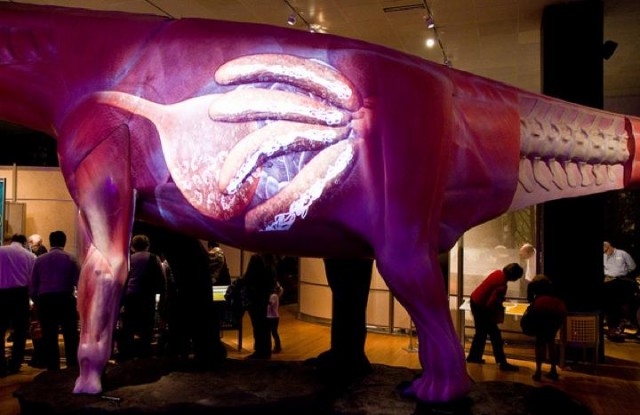
Dinosaur media fail. No speculation without representation! http://www.theawl.com/2011/05/sauropod-swindle-the-monstrous-lies-of-the-worlds-largest-dinosaurs

Get your button here. http://www.etsy.com/listing/50800011/how-does-computer-programming-work-magic
One of the challenges though, is that many things the lay person thinks are pure speculation are not speculation at all, but are backed up by lots of evidence that there is simply not enough time to go into. Many computer programmers simply tell their clients what they do is magic because to answer their questions adequately would take months of training to even get them to the point they could understand the answer. Would you tell a computer programmer what they are doing is pure speculation simply because you don’t understand it? We aren’t trying to be elitest, there is just a lot of information we don’t have time to transmit. There is simply too much going on, too much data, too much research for anyone to keep track of it at all. Even professionals who try to keep up as part of their full-time job can’t do it. So it would be foolish to think anyone who doesn’t spend most of their time studying the research could possibly have a good grasp of the intricacies and quantity of data. It therefore becomes quite the annoyance when people say you can’t know something when they have no idea how much we do know. Many of those things people say we can’t know have been studied for decades by many people who have spent their lives figuring out how to go from speculation to concrete data and hard fact. Most people don’t realize the extreme levels of simplification it takes to get some concepts across because no one can provide all the data backing up those assertions without having their audience earn a graduate degree in the process.
Is all this me telling you to just trust whatever we say? Absolutely not. But don’t expect to come in on the ground floor and know what is going on at the top any more than you could expect to speak perfect French by catching someone speak a few words on TV. Understand that you are only getting the tip of the iceberg. What you see on TV is a seriously flawed transmission of a few grains of knowledge from a mountain range of data. Learn as much as you can from reliable sources. The more you know, the richer your interactions with professionals and the more in depth we can talk to you. We will be happy to share with you everything we know, that’s our job. But what we tell you is highly dependent on the level at which you come to us and the amount of time people are willing to spend. Also understand the quantity of data is more than any one person can understand, even those whose job it is to do so. That is why we have many people studying problems. No one can have all the answers. That is why we keep asking questions. Being open about what we know and what we don’t allows us the freedom to learn more and shows us the path about where to go next. Scientists don’t leave things at speculation, they try to figure out how can we go from speculation to understanding. But if you want to understand all the steps involved, may I suggest grad school?

Dino Sites to Avoid
I have been working on lectures on early amniote evolution, along with the following reptilomorph and synapsid lectures for my vertebrate paleontology course. We will be getting into dinosaurs and the other Mesozoic animals very soon, hooray! However, in preparing these talks, it has brought to my attention just how prevalent two sites in particular are: Reptileevolution.com and Pteresaurheresies.wordpress.com.

When I did a search for “pterosaur”, Google actually responded by saying “Did you mean pterosaur heresies” and provided images that all but one are either from the site or sites complaining about the site.
This is quite unfortunate. Both sites present an abundance of beautiful artwork done by a stellar paleoartist. There is an abundance of information on the animals and their relationships. All in all, the websites look fantastic and are quite the draw for paleo-enthusiasts.
But it is all wrong.
None of the hypotheses presented on these pages is accepted by virtually any other paleontologist. The techniques used to gather the information is not considered valid and no one who has tried to reproduce the data using the methods have had any success.
I won’t get into details about why the websites are wrong. I am frankly not qualified enough to provide a step-by-step breakdown of the problems (not being an expert in either pterosaurs or basal tetrapods), nor do I really have the time. I will say that many years ago, I heard the author of these websites give a talk about his evidence for a vampiric pterosaur and even as a young undergraduate, it was clear to me that neither the technique nor the conclusions were valid. I found it very unfortunate because the idea of a vampiric pterosaur was incredibly cool and the technique, which involves detailed image study, is useful in many contexts. However, it is very easy to let personal biases enter into conclusion based on these methods, to allow oneself to extrapolate well beyond anything the data can actually support. Oftentimes, those biases are completely unknown to the observer simply due to the way our brains interpret sensory input and modifies them based on past experience. We really do not see everything we think we see, which is why the scientific method requires other scientists examining your conclusions and your methods and trying to poke holes in your ideas. So it is vital to recheck one’s conclusions with many detailed images from various angles and lighting methods and, most importantly, detailed examination of the fossil itself.
So instead, I will point you to articles written by people who are experts in the very animals that are discussed on those pages and what they have to say about them. The first is an article by Dr. Christopher Bennett, who is an expert on pterosaurs. In this article, he discusses the validity of the techniques and discusses specific claims of two pterosaurs in particular, Anurognathus and Pterodactylus. Anurognathus is a very odd-looking pterosaur and is quite aptly named “frog mouth.” Pterodactylus is probably the most famous pterosaur next to Pteranodon and is why so many people mistakenly refer to all pterosaurs as pterodactyls. Dr. Bennett does an excellent job critiquing the science in a professional and readable way.

Dr. Bennett’s article.
The second article is a blog post by Darren Naish, a noted researcher and science author that has researched pterosaurs and many other animals who has a deep understanding of both the accepted science and the author of these websites and the work presented therein. Here is what he says: “ReptileEvolution.com does not represent a trustworthy source that people should consult or rely on.Students, amateur researchers and the lay public should be strongly advised to avoid or ignore it.” The emphasis is completely his. The post is quite long and discusses several aspects of the work, discussing the accepted science and the material on the websites that is not accurate, including the techniques used to arrive at the conclusions, both accepted techniques and those by the website author that are not.
The next site is an article by Pterosaur.net, a website devoted to research on pterosaurs by pterosaur researchers. It is a brief article that uses Naish’s article as a starting point and continues on with a discussion of why they think it important for people to know why these sites should be avoided. To quote: “The issue taken with ReptileEvolution.com is not that it exists, but that it’s internet presence has grown to the point that it is now a top-listed site for many palaeo-based searches. Tap virtually any Mesozoic reptile species into Google and either ReptileEvolution.com or the Pterosaur Heresies is likely to be in the first few hits. The situation is even worse for image searches, which are increasingly dominated by the many graphics that Peters’ uses on his sites.” This would not be a problem that the sites are so well known if they were correct, but their prevalence presents a highly flawed version of what scientists really think. People are taking these sites as truth, when in fact they are regarded by professionals as seriously wrong.
Finally, Brian Switek, a science writer who authors the blog Laelaps, which moved from Wired Science Blogs to National Geographic and the now-defunct blog Dinosaur Tracking for the Smithsonian, wrote a piece on the site, in which he urged more paleontologists and paleontology blogs to call out misleading websites like these. In that spirit, I hope I can help some avoid getting a mistaken impression of dinosaur science and help steer them to better, more reliable sources.
* If you are wondering why I say “the author” or “the artist” rather than using the person’s name, it is because I don’t want this to be about the person, but the information. I don’t personally know the author, nor have I ever had direct contact, so I have nothing to say about the person. The work, however, can be and should be open for criticism, just like any other researcher, including my own.
Fossil Friday! Today we’re being a stick in the mud.
On Monday, we posted this picture of an Arkansas fossil. Were you able to figure it out?
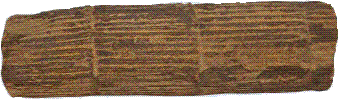
This is a fossil of Calamites (watch your spelling, we want to avoid any calamities). Calamites was a relative of the modern-day horsetails, Equisetum. But unlike today’s horsetails, which are generally only a meter or so in height (although some giant horsetails can grow up to 7 meters or more), Calamites grew up to 30 meters (100 feet).
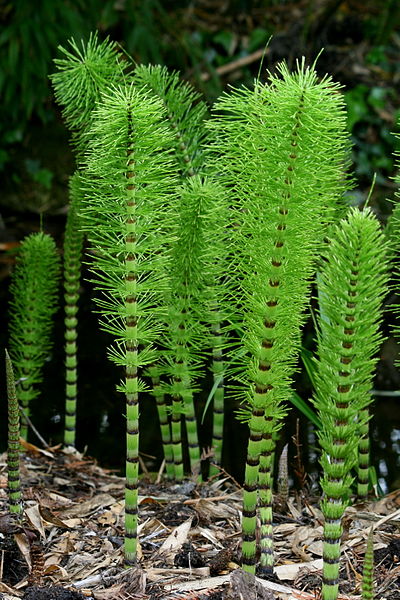
Great Equisetum. Wikimedia.
Equiseta often grow clonally, spreading the rhizomes widely through the surrounding ground, forming large clumps of plants that are essentially the same plant, connected via their roots. Assuming Calamites did the same thing, it has been estimated “they may have been the largest organisms that ever lived.” This group of plants is unique in the incorporation of silica into their stems, giving rise to one of their common names being scouring rushes.
This group of plants first appeared in the late Devonian, but really had their heyday in the Carboniferous Period, although they died out soon after in the Permian. The Carboniferous is so named because most of the world’s coal was formed during this time. The reason for this is because of the difficulty in digesting plant matter. Cellulose, the primary ingredient in plant cell walls and what we call “dietary fiber.” Even today, other than fungi and some bacteria, there is precious little that can break it down. Lignin, the other main component of plant cells walls, otherwise known as “wood,” is even harder to break down.
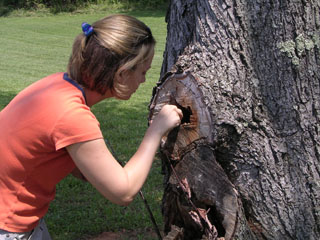
And they think they have a termite problem. http://www.ces.ncsu.edu
The only thing that can really digest it is white rot fungi. Back then, there was little to nothing that could eat it. As a result, dead plant matter tended to sit around for a very long time, making it much more likely to accumulate and form coal. Once the enzymes needed to break down lignin evolved, white rot fungi found themselves with a hugely abundant food supply and acted like teenaged football players after a game at an all-you can-eat buffet. And thus ended the Carboniferous Period, in a massive bout of white rot.
Like modern horsetails, Calamites preferred wet soils around rivers and lakes, cropping up all over the world. While they avoided the standing water of the swamps, they flourished any place that regularly got wet, so levees and floodplains were good environments for them. There were no angiosperm trees at that time, what was there were forests of giant Calamites and ferns. Plants called lycopods, most commonly Lepidodendron, dominated the swamps along with the ferns, which were pretty ubiquitous.
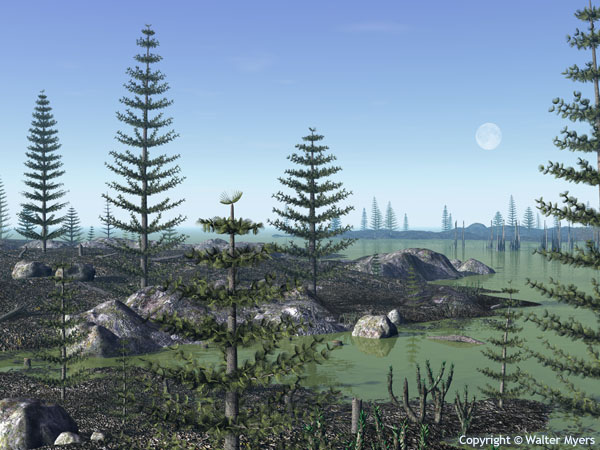
Calamites landscape. Illustration by Walter Myers, http://www.arcadiastreet.com
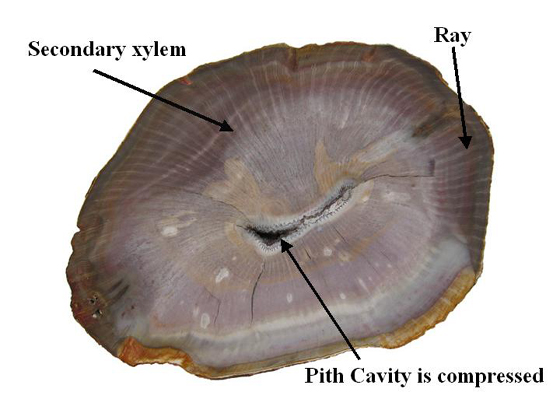
Calamites cross section. Petrifiedwoodmseum.org
Calamites’ modern counterparts are all herbaceous perennials, so Calamites is unique in the group for having a woody trunk. They form extensive underground rhizome networks, growing large clumps of clones from the rhizomes. The leaves form regularly spaced whorls around the stem, creating the horizontal lines breaking up the ridges running vertically up the trunk on Calamites. Inside, the xylem forms rays running from the exterior to the pith in the center. Oftentimes, the pith rots away, leaving a cavity that gets filled with sediment, forming an internal cast, or steinkern.
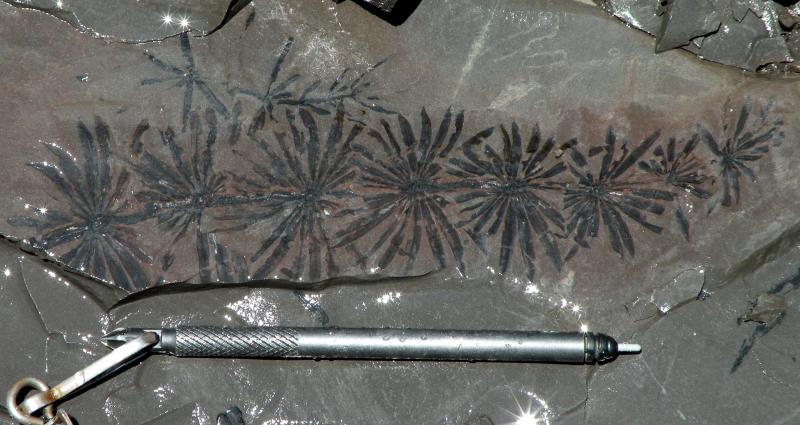
Calamites showing leaves. Arkansas Geological Survey.
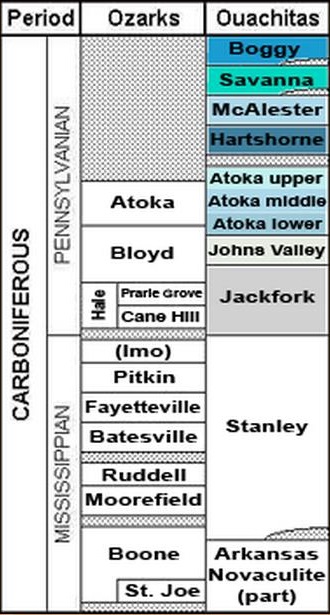
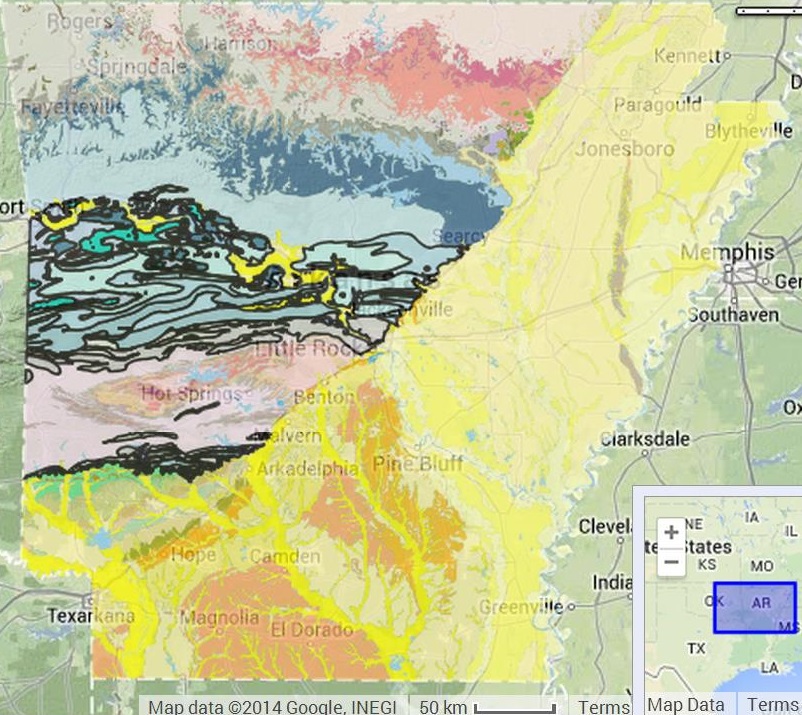
As a plant fossil, anyone can legally collect Calamites fossils as long as they are not on National Forest property (nothing is allowed to be collected in National Parks and Forests). Good places to look for Calamites would be among the Pennsylvanian (Late Carboniferous) rocks in the Quachitas and Ozarks. While Calamites may be found in rocks of Mississippian (Early Carboniferous) age, the rocks in Arkansas from that age are primarily marine. Good for finding sea shells, but land plants like Calamites are going to be rare, only there as a result of being washed in by a storm or some such. You will be much more likely to find them in rocks like the Atoka Formation on both sides of the Arkansas River Valley. Most of the Ozarks is Mississippian, but much of the Ouachitas is Pennsylvanian, so are much more likely to have them. You might find them in the Hartshorne sandstone (seen best capping Petit Jean Mountain), but plant fossils are rare and fragmentary. You would have better luck in the McAlester Formation overlying the Hartshorne. You can also try the Savanna and Boggy Formations, which are also of Pennsylvanian age.
Mystery Monday!
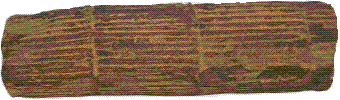
It’s time for Mystery Monday! Here is a fossil that can be found in Arkansas, but is completely different from anything I’ve put up here before. Let’s see if you have the paleontological fiber needed to solve this puzzle, or do you lack the stomach for it? 🙂

 paleoaerie