Fossil Friday, to bear or not to bear, that is the question
It’s Friday again. Were you able to get the answer to Monday’s fossil?
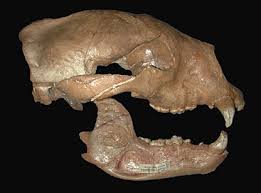 The skull shown in the picture belonged to Arctodus simus, the giant, short-faced bear (the not-so-giant short-faced bear, A. pristinus, was smaller and lived in more southerly areas than A. simus). Arctodus lived in Arkansas and much of North America during the late Pleistocene, from less than 1 million years ago up to about 12,000 years ago, when most of the large North American Ice Age fauna went extinct. Arctodus was the North American version of the European cave bear, Ursus speleaous. While the European cave bear was a close relative of most modern bears, Arctodus was more distantly related, its only living relative being the spectacled bear, Tremarctos ornatus. It is sometimes considered possibly the largest terrestrial, mammalian carnivore that ever lived, standing over 3.5 m ( 11.5 ft) tall. Even on all fours, it was almost 2 m (6.5 f) at the shoulder. You would have to get at least 4.5 m (almost 15 ft) up a tree to avoid its reach, assuming it didn’t just tear the tree down or shake you out of the tree. It weighed in at a full ton and could run 40 mph (over 60kph). However, that is also the top range of modern Kodiak brown bears, otherwise known as Alaskan grizzly bears. In the wild, the bears don’t usually get over 1500 pounds (although they can), but the largest ever known was a bear in the Bismarck, ND zoo that weighed 2130 lbs at his death and previously weighed possibly close to 2400 lbs, although he was a very fat bear. There is another bear pelt on display at Space Farms Zoo and Museum in New Jersey that is claimed to be from a bear over 12 ft. tall and over 2,000 lbs, but those claims remain unverified are considered by most to be exaggerated. There is another bear that may have been even bigger. Arctotherium angustidens lived in South America about three million years ago and stood almost 3.5 m tall, so similar to Arctodus and the largest of extant bears, but was much more robust, weighing in the neighborhood of 3,500 lbs.
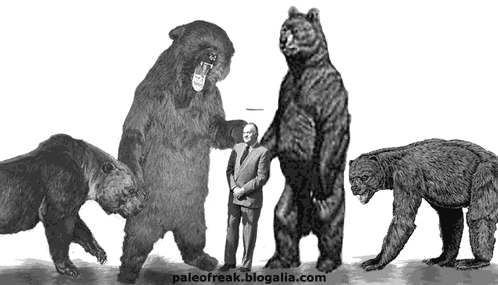
Arctodus is generally known for its long legs and short face. However, research in the past decade has indicated that its legs were neither longer than expected, nor was its face all that short. It was simply big. Like other bears, it is thought to be fairly solitary most of the time. Contrary to many depictions, it was not particularly adapted to running quickly, considering that modern grizzlies can run 30 mph. What may have made people think they were unusually fast is a combination of their size giving them long legs and tracks that have indicated they used a pacing gait, with the legs on the same side of the body moving in unison, rather than in opposition like most other animals. This sort of gait is typically used in animals with longer legs or at faster trots. Camels use it and dogs and cats, among others, do it when maintaining a trot before they break into more of a gallop. However, the pacing gait is not indicative of a fast-running animal, but of an animal that maintains a quick pace for long distances, it bespeaks of endurance, not speed.
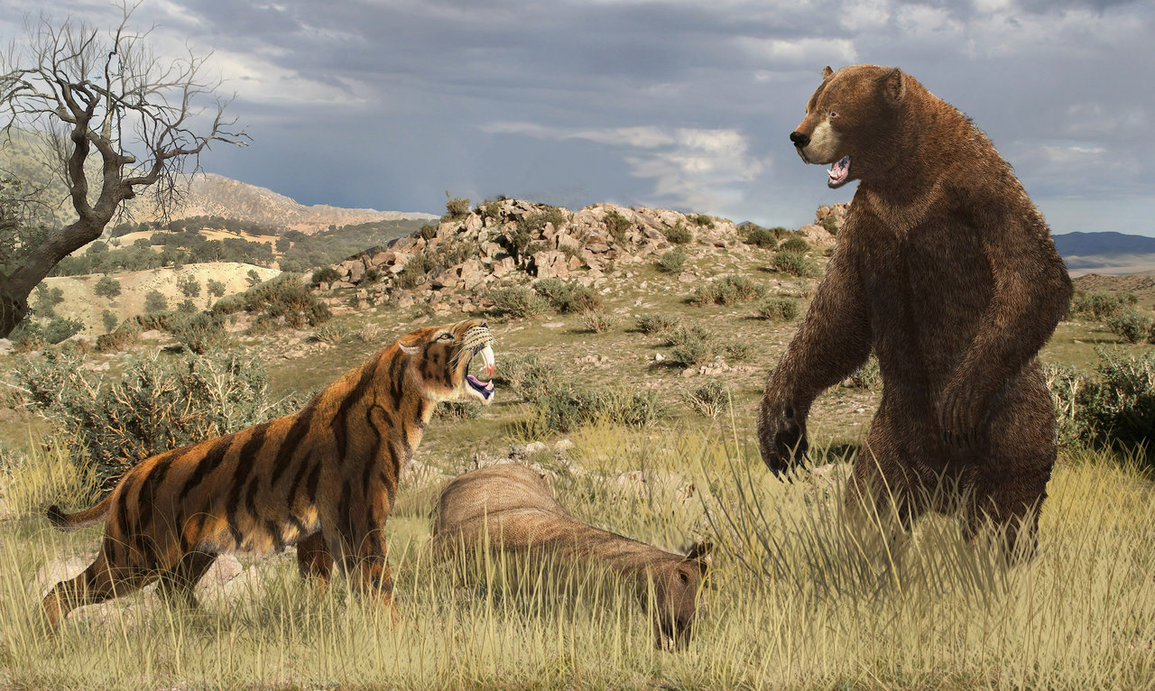
Like most bears, Arctodus is thought to have been omnivorous, eating both plants and animals. There have been several hypotheses concerning its diet, from mostly scavenging to hypercarnivorism. It was certainly capable of bringing down large prey, although its limbs were not as flexible as most high level predators, nor were they particularly robust for their size, leading some to think they scavenged, although they would be hard-pressed to compete with giant vultures in scavenging and recent work indicates the tooth structure was not sufficient for chomping through bone. They may have been better suited for foraging plant material with their unusually flexible wrist giving them an almost semi-opposable thumb, much like pandas. This suggests possible tree-climbing to some workers, although Arctodus was a very large animal to be climbing trees. Besides, it typically lived in more open, grassland environments the majority of the time, so it is unlikely to have been adapted for tree-climbing.
They went extinct roughly 11,000 years ago, along with a large number of other large species. A reduction in rich food supplies is thought to have caused the extinction of the large herbivores. This would have placed a great deal of stress on the carnivores, causing increased competition. The dire wolves lost out to the modern grey wolves during this time, chiefly thought to be a result of the gray wolves being able to hunt and subsist on smaller and fewer prey than the larger dire wolves. This same reasoning would apply to Arctodus as well, which had to compete against both wolves and other bears, for a greater percentage of the share to fuel its larger body. On the other hand, evidence for this hypothesis has been lacking in analyses of tooth wear.
If you want to see more of Arctodus, make your way to the La Brea Tar Pits in Los Angeles. many bones of this bear have turned up from the tar and are on display at the Page Museum.
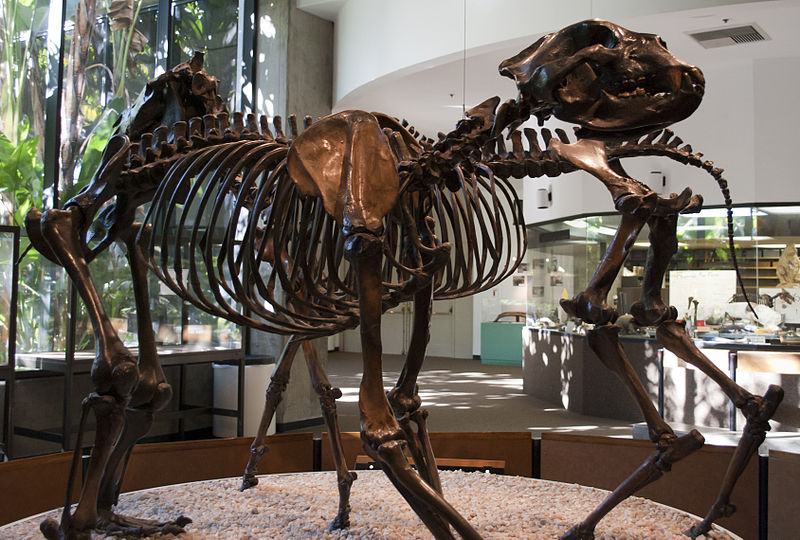
Arctodus from the la brea Tar Pits at the page Museum. Wikipedia.
Mystery Monday, snow edition

The weather forecast this week is for snow. So in going with the theme lately of Ice Age animals, I thought I would bring you another one for this week’s Mystery Monday fossil. This picture doesn’t have a scale, so I will just say this skull is bigger than yours (under the assumption that all my readers are Homo sapiens or within the same size range, my apologies to the exceptionally macrocephalic).
Fossil Friday, a fossil of not quite mammoth proportions
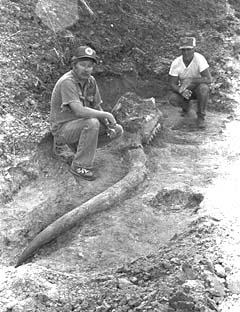 It’s time to reveal the answer to Monday’s Mystery Fossil. We had three people who correctly identified this as the skull of Mammut americanum, the American Mastodon.
Mastodon bones have been found throughout Arkansas, although almost all have been found either in northeast Arkansas between Crowley’s Ridge and the Mississippi River or along the Red River in Southwest Arkansas. According to the Arkansas State University Museum in Jonesboro, Arkansas has more mastodon finds than any other state in the mid-south region, with at least 20 different skeletons. Most of the work on them has been done by Dr. Frank Schambach and others of the Arkansas Archaeological Survey, headquartered at the University of Arkansas at Fayetteville, along with members of the Arkansas State University Museum. This particular mastodon was excavated by Dr. Schambach with the help of the Arkansas Archaeological Society along the Red River in Southwest Arkansas, I think in 1987, although I am not sure of the date yet.
Mastodons were related to elephants, although not as closely related to modern elephants as mammoths. Mammoths have also been found in Arkansas, most notably the Hazen mammoth, found in 1965. That specimen was a Columbian mammoth (Mammuthus columbi), a less hairy version of the wooly mammoth (Mammuthus primigenius). They lived across much of North and Central America during the Miocene and Pliocene, although they are known mostly from the Pleistocene in Arkansas, the heyday of the Ice Age, which is when people traditionally think of them living. They were similar in size to modern elephants.
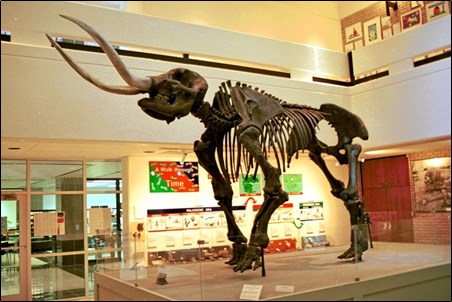
Mastodon, Arkansas State University Museum
The teeth of mastodons, mammoths and modern elephants tell an interesting story. Modern elephants have a wide diet of vegetation from grass to fruit and tree limbs. The Asian elephant has teeth that are more plate-like in form, making a series of ridges that create an excellent grinding surface. African elephants spend more time in forests and bush lands, with a corresponding higher amount of bushy vegetation in their diet. Their teeth are large, multi-rooted teeth with a series of ridge-like cusps. Mammoths take the plate-like grinding surface to an extreme as an adaptation to the grasslands they frequented. Mastodons, on the other hand, specialized in the opposite direction, with large, prominent cusps suited to a more forested environment and diet. Thus, mastodons and mammoths formed a bracket surrounding elephant ecology.
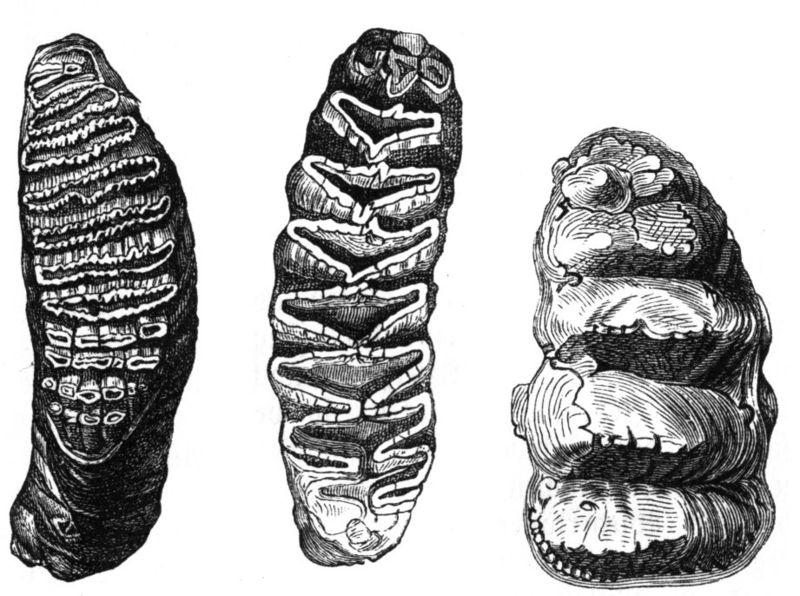
Asian Elephant (Elephas), AFrican Elephant (Loxodonta), Mastodon (Mammut). Wikimedia
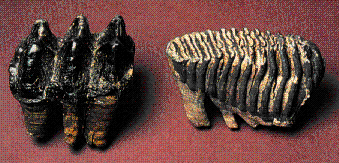
Mastodon (left), Mammoth (right). http://www.igsb.uiowa.edu/
Work that has recently come out has shed new light on why they went extinct. People have long argued over whether climate change or humans wiped out the megaherbivores at the end of the last ice age. The Overkill hypothesis postulated that early humans hunted them to extinction. There is also the alternative that other actions by early humans contributed to their extinction. However, while there has been plenty of evidence indicating humans did hunt mammoths (e.g. the Clovis people at the Dent site in Colorado), the hypothesis has come under fire for the lack of widespread hunting evidence and timing issues, with research indicating the megaherbivores were already going extinct before humans appeared on the scene. The other hypothesis, climate change, has gotten more support from a study of plant fossils. According to the new data, the early tundra environments were dominated, not by grass, but by forbs, weedy herbaceous plants with more nutrients than grasses. An earlier glaciation 20-25,000 years ago dramatically reduced the abundance of these plants. When the weather warmed up, the forbs increased again, but never approached their previous levels. When the next glaciation hit, the forbs mostly died out, allowing the less nutritious grasses to take over, which greatly reduced the amount of herbivores the land could support. Of course, this does not mean that humans had nothing to do with the extinctions, but it does mean they were likely not the primary cause, more likely simply throwing the last spear into the coffin of the great herbivores.
That’s it for this week. Check back Monday for a new mystery fossil. Have a good weekend.
You found a fossil… now what? (all the details!)
One of the questions I get often is what should you do if you find a fossil. I have been meaning to write a post discussing that, but I found that someone else had already written a very nice discussion on that very topic. I thought why duplicate the efforts of someone else who has done a fine job already? So instead of writing my own post, I am just going to refer you to their blog post. So without further ado, may I present…
Questions from the Bill Nye/Ken Ham debate on creationism
Bill Nye the Science Guy debated Ken Ham, a young earth creationist who runs Answers in Genesis and the Creation Museum, Tuesday at the Creation Museum in Kentucky. The question they debated was “Is creation a viable model of origins in today’s modern, scientific era?” I won’t get into the debate itself, you can watch the debate in many places, such as here and here and decide for yourself who won or lost and whether or not they presented convincing arguments. What I do want to get into here is an article I saw called “22 messages from creationists to people who believe in evolution.” It illustrates why paleoaerie was created in the first place. When I read these statements from creationists, the lack of comprehension of really basic science concepts was highly discouraging. This isn’t even just about evolution, it’s about basic science understanding and logical thought processes. If one doesn’t even understand what a theory is, how can that person be expected to make a rational decision about anything? Life becomes nothing more than random guesses. We are blind men in a watch tower. “Blinken! What are you doing up there?” “Guessing? I guess there’s no one coming.” That’s no way to run your life, much less the whole of society.
So I thought I would provide at least some sort of answer to these questions. Many of them are questions that are quite commonly raised, so it is worth at least attempting to answer them. The first thing to address, though, is the title of the article itself. Scientists do not “believe” in evolution. It is not a religion or ethical/moral code. Scientists accept evolution because of the staggeringly huge amounts of evidence that supports the theory, not because some scientific leader told them they must believe it or go to science hell.
1. Bill Nye, are you influencing the minds of children in a positive way?
I’m not Bill Nye, but for me, I would say yes. Any attempt to teach children how to think rationally, to question how the world works and to use evidence to attempt to answer those questions, is a positive influence. Teaching children to obey and believe simply because they are told to without question is a bad influence. That is how horrific atrocities are committed and accepted by a blind populace. Every great discovery, invention, or acheivement came about because someone asked a question (more likely several questions) and trying to figure out the answer beyond just accepting what they were told. The bow and arrow, agriculture, medicine, computers, basic housing, nothing man-made would exist if we never asked questions and strived for answers. Creationism the way Ken Ham and others formulate it, is telling people to NOT ask questions, the only answer you need is “God did it.” That sort of thinking not only denies the reality of our shared experiences, but dooms civilization to failure and would have kept us in the trees. We would never even have made it to the caves. That is why this is important.
2. Are you scared of a Divine Creator?
There are two (more than that actually, but two is what I am sticking with here) ways to answer that question. If one starts with an atheist point of view, one cannot truly be afraid of something you don’t believe exists. But this question falsely assumes that evolution and religion are mutually incompatible, that one cannot believe in evolution and a Divine Creator at the same time. This is wrong. Pope Benedict stated that evolution is true, even calling the idea they are incompatible an absurdity. Pope Pius XII endorsed evolution, as did Pope Paul II, and Pope John Paul II called evolution “an effectively proven fact.” Surely no one could call these leaders godless or lacking in Christian religion. Billy Graham, an influential Baptist Evangelical leader, was not opposed to evolution. Pat Robertson, leader of the 700 Club, has called Creationism a joke and that a 6,000 year old earth is ridiculous. He has no problems with theistic evolution, only nontheistic evolution. In other words, he accepts in God-guided evolution. Truth be told, there is NOTHING in evolutionary theory that denies God. God is not a necessary part of the theory, but it does not claim God did not guide it. Francis Collins, Director of the National Institute for Health, is well known to be a devout religious man, yet also firmly accepts evolution.
3. Is it completely illogical that the earth was created mature, i.e. trees created with rings…Adam created as an adult…?
Yes. I think it is illogical. For that to be true, you have to admit that God is intentionally lying to you. Why would God create an earth that gave all appearances of being much older if God did not expect you to accept the evidence God provided? Is it logical to assume God lies to you? If so, why would you worship a God that is a liar?
4. Does not the Second Law of Thermodynamics disprove evolution?
No. The Second Law of Thermodynamics states that 1. Heat will not flow from a cold object to a hot object. 2. Any system which is free of external influences becomes more disordered with time, which can be expressed as entropy. 3. You cannot create a heat engine which is 100% efficient in converting heat to useful work. For example, a (working) refrigerator is clearly colder on the inside than on the outside. It maintains this temperature by pulling heat from the inside and dumping it outside. One might say that this violates the 2nd law, but it doesn’t because it uses the fact that pressure and temperature are intertwined. It pumps a coolant that absorbs heat from the interior, thereby becoming less dense. It then takes that coolant and compresses it, releasing the heat so the coolant than then start the cycle over again. This requires energy to do this. The refrigerator uses electricity to add energy into the system, which is lost through this process. Overall, the entropy goes up, despite the refrigerator becoming less entropic on the inside, that disorder is simply moved outside. In the same way, the earth is collects a vast amount of energy from the sun. That energy is absorbed by plants, which then gets (very inefficiently) converted to work energy by themselves and everything that eats them. Overall, the process is extremely inefficient. Without the sun, no life could exist on earth, entropy could not be fought. But the sun supplies so much energy, it is simplicity itself to create order in some areas even while disorder of the whole increases.
5. How do you explain a sunset if there is no God?
Disregarding the spelling mistake (English teachers, where are you?), this question doesn’t even make sense. Sunsets happen because the earth rotates on its axis. Stand in front of a light with a little Lego person on your forehead and turn around. That Lego person on your forehead will experience a “sunset” for every revolution you make. Now imagine that process as you standing on the earth and the light being the sun.

6. If the Big Band is true and as taught as science along with evolution, why do the laws of thermodynamics debunk said theories?
They don’t. See above. Both evolution and the Big Bang Theory are formulated with the laws of thermodynamics in mind and are fully compatible with them. If they weren’t, no scientist would take them seriously. They are, so we do.
7. What about Noetics?
To be honest, I’ve never heard of Noetics. One minute while I perform Google-fu…According to Wikipedia, “noetics is a branch of metaphysical philosophy concerned with the study of mind and intellect. Noetic topics include the doctrine of the agent/patient intellect (Aristotle, Averroes)[1] and the doctrine of the Divine Intellect.” What about it? This has nothing to do with evolution. If you are asking where consciousness comes from, one first has to define what you mean, as there is no universally accepted definition. However you define (presuming one is using a rational definition), humans are hardly unique in being “conscious”. The idea that we are the only animal that is conscious is simply a conceit to make us feel special. There are gradients of consciousness exhibited by a wide range of animals that are not human. Therefore, it seems to have evolved. If one is talking about the idea that you can know the universe simply via self-examination, there is abundant evidence that shows just how fallible human perception is. There are entire fields of study devoted to the topic. It is how magicians perform their craft, why marketers are so successful. As helpful, beneficial, and worthwhile it is, self-examination without reference to the outside world cannot even accurately teach you about yourself, much less the universe.
8. Where do you derive objective meaning in life?
Again, this has nothing to do with evolution. Meaning in life is a personal decision, not an objective part of the universe. The meaning of life is what you make of it. Thus, an objective meaning of life is a non sequitor as it is subjective by definition.
9. If God did not create everything, how did the first single-celled organism originate? By chance?
Yes. There are a lot of hypotheses about how that happened, but we don’t honestly know. At any rate, the question has nothing to do with evolution. Evolution does not deal with the origin of life, only what happened to it after it was here. If you want to understand the physical processes that led to the origin of life, I suggest you talk to a biochemist and biophysicist. That is in their bailiwick, not in evolutionary theory. But let’s ask that question in a different way. If God created everything, how did God get created? Did He create himself? And sorry, but the answer of “He always existed” is simply a copout. The other problem with this question is the assumption that there are only two possible mutually exclusive answers, that it is either evolution or God. What if it were aliens? No, I’m not seriously suggesting that, if for no other reason than it only pushes the question back to where the aliens come from and so answers nothing. I am simply saying that other possibilities exist. They are also not mutually exclusive. You can accept evolution AND God if you wish. You may as well ask how can a pilot fly if he didn’t invent airplanes. One is not dependent on the other, nor does one being true rule out the other.
10. I believe in the Big Bang Theory…God said it and BANG it happened.
That’s not a question, just a statement of opinion. It also has the serious flaw in that it indicates the person refused to even consider the question, going on nothing more than blind faith. That’s ok in a religion, but is a horrendous failure in science. That sort of thinking also fails the reality test, in that reality does not care what you believe. You may believe you can fly and jump off a tall building, but unless you have brought along a parachute or hang glider or some such object, the ground will still kill you. Personally, I would rather someone tested the parachute before I staked my life on it.
11. Why do evolutionists/secularists/huminists/non-God believing people reject the idea of their being a creator God but embrace the concept of intelligent design from aliens or other extra-terrestrial sources?
First off, English teachers, help this man. Second, almost no one does, so this question makes no sense. It lumps a whole lot of people into a very strange category. Most people who “embrace the concept of intelligent design from aliens” are generally considered whackjobs and not taken seriously, so it both has nothing to do with evolution and everything to do with a very incorrect view of people who accept evolution. The accepted scientific thinking on life originating from aliens is that there is no proof or any real evidence for that idea, so it is not considered at all scientific and is therefore unaccepted. There are a few people that support the idea, but as far as I know, no one, not even them, really consider it a scientifically supported hypothesis.
12. There is no inbetween…the only one found has been Lucy and there are only a few pieces ot the hundreds necessary for an “official proof.”
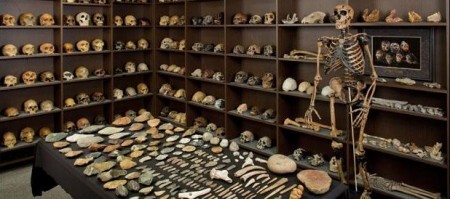
First off, there is no “official proof” of anything in science. There is either evidence supporting it or not supporting it. Secondly, there are far more fossils than of just Lucy. There are multiple species of Australipithecus, as well as Ardipithicus, Sahelopithicus, Paranthropus, Homo habilis, Homo erectus, Homo neanderthalensis, etc. May I suggest you spend some time perusing the Smithsonian site on human origins? They have quite a nice discussion of human origins and present far more than just Lucy.
13. Does metamorphosis help support evolution?
Yes, it does. Careful study of how different animals undergo metamorphosis has helped to elucidate the relationships between a large number of different animals. The study of amphibian and insect relationships requires a detailed examination of how those processes play out and they have been exceedingly helpful in understanding the evolutionary pathways in these groups. There are still plenty of unanswered questions, but that is why we do research, to try to answer those questions. Moreover, research on those topics is an important part of medical research on regeneration, in the hope that if we can fully understand it in other animals, we may be able to bring that knowledge to bear on helping humans do it to, so that we may one day grow back lost limbs and organs and not have to depend on prosthetics.
14.If evolution is a theory (like creationism or the Bible) why then is evolution taught as fact?
If evolution were indeed a theory like creationism, it would not be taught as fact, it wouldn’t be taught at all because it would be only fit for a religion class. But it is a theory in the same way that gravity is a theory. There is no law of gravity, there is a Theory of Gravity that explains the mathematical relationships and how it works in the universe. A scientific theory is not simply a guess. It is a scientific concept that explains a large array of observable facts, a concept that has been tested and retested and tested again by lots and lots of people. Scientific theories are constantly being revisited to see if new observations still support it. The simple fact of the matter is that no one has been able to provide any better hypothesis that explains the observable data. Sorry, but “God did it” is not a verifiable hypothesis. One cannot even proof or disprove God exists, God is a concept that falls outside of science. If someone can come up with a way to either proof God exists that can be objectively tested or can come up with a better hypothesis that disproves evolution, again, with objective, verifiable facts, they would become famous and would win the Nobel Prize. That hasn’t happened, so until it does, we will stick with evolution.
This question not only misunderstands what a scientific theory is, but it misunderstand what the theory of evolution is. Here then is the essence of evolutionary theory: everything changes. Specifically, living organisms change. Even more specifically, we can observe those changes in the genetic distributions within populations. If we see genetic changes in populations, we have proven evolution happens. Basically, if you can agree that you are not a clone of your parents, you accept evolution. That is why we teach evolution as a fact, because it is.
15. Because science by definition is a “theory” – not testable, observable, nor repeatable, why do you object to creationism or intelligent design being taught in school?
Because science by definition is none of those things. To be considered science, it must be testable, observable, and repeatable (at least in some aspect). Thus, a dinosaur bone is not science. It is a fact. It exists. That it is a dinosaur and that a dinosaur means a specific thing is science because it is a testable concept. Other people can take that definition of what a dinosaur is and make their own observations to test it. They can make predictions and then see if those predictions hold up. If it can’t do this, it’s not science. Something that is not testable, observable, nor repeatable is called speculation or religion, but most emphatically NOT science. That is why we resist creationism or intelligent design being taught. They have no evidence to support them, they have no testable predictions that would support the ideas and what few predictions they have made have been proven wrong. Therefore, they have nothing to do with science and should not be taught as science. If they are going to be taught in school, it should be limited to a religion class. Even then, that religion class, to be allowable in a public school, would also have to teach equally other religions. So unless you are willing to have Islam, Judaism, Shintoism, Buddhism, Satanism, and any other religion taught on an equal footing, you can’t have them in a public school that is bound by law to not advocate any single religion over another. To do so violates our most fundamental right, freedom of religion.
16.What mechanism has science discovered that evidences an increase of genetic information seen in any genetic mutation or evolutionary process.
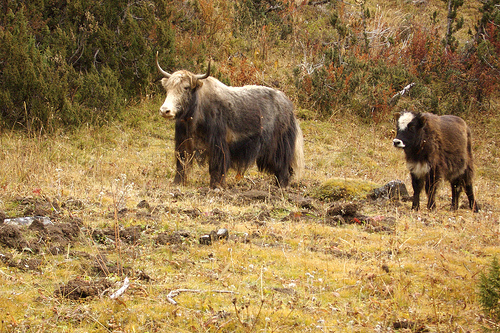
Dzo, fertile crossbreeds of cows and yaks. Wikipedia.
There are actually several processes. It would take several books to adequately answer that question, so I will just mention a few in brief. Genes get accidentally duplicated all the time, our genomes are filled with duplicated genes. Most genes we have are in fact part of gene “families” which originated from the duplication of an earlier gene. When this happens, the duplicated gene is then free to evolve into something else. The original gene is still constrained by its original function, so it has a limited ability to change without breaking. However, that spare gene can change independently and it doesn’t matter if it can no longer perform its original function. It then has the ability to over time pick up a new function. Another way to increase genetic information is through viral infections. Our genome is about 8% viral origins. Viruses function by inserting themselves into the genome of their host and using the host cell to make the viral proteins. When the virus copies itself and spreads to other cells, it very often takes a small part of the host genome with it. Also, quite often, a virus gets inserted into a host genome, but loses its ability to replicate itself, thereby getting trapped in the host cell. If that cell happens to be a reproductive cell, which happens, it will get passes on to offspring as a permanent part of the genome. This is in fact virtually the entire basis of the field of gene therapy. Another way is good old fashioned sex. Hybridizations occur between closely related species all the time. Most of the time, those hybrids are sports, they can’t reproduce, but sometimes they can. Red wolves and Gray oaks are great examples of species that have been created through hybridizations. Plants are the ultimate masters of hybridization. They hybridize and create new species at the drop of a hat. They also readily duplicate their entire genomes. Of course, bacteria and many prokaryotes regularly swap genes among each other in a process called conjugation. There are many other ways, this is just the tip of the ice berg, but I hope I have demonstrated that increasing genetic information is really quite easy and happens all the time.
17. What purpose do you think you are here for if you do not believe in salvation?
Again, another question that has nothing to do with evolution. How does this even relate to the topic? The other flaw in this question is that it assumes we all have a purpose at all. What evidence can you give me that anyone has a purpose? What evidence can you give me that you can know the mind of God well enough to know what that purpose is? What is the purpose of a baby that dies at birth? What is the purpose of a person that never has children? Why do we need a purpose? Each of us are here because our parents had unprotected sex. There is no requirement that it be any deeper than that. It is fine to ask that question, but honestly, what does that have to do with science or evolution? For me, I think our purpose is what we choose to make it. Only you can answer what your purpose is and only if you decide to create one for yourself. As far as Salvation goes, why do we need to believe in Salvation? Why do we need Salvation? For us to need Salvation, that requires that God made us imperfectly so that we need to be saved. Why would God create something that needed God to rescue it? What need did God have to create something who’s only purpose was to worship God and ask to be rescued? These are not scientific questions. They are religious, philosophical questions. They are by their very nature outside the realm of science, at least, until someone comes up with a way to objectively test them. But they most certainly do not have anything to do with whether or not evolution occurs.
18. Why have we found only 1 of “Lucy”, when we have found more than 1 of everything else?
See question 12 for “Lucy”. To add to that, most fossil species consist of at most a few specimens. So it is not true that we have found more than one of everything. But more to the point, we have found seveal specimens of Austalopithicus, several different species in fact. So it is not true that we have only found one. There are numerous examples.
19. Can you believe in “the big bang” without faith?
First off, “the big bang” has nothing to do with evolution. It doesn’t even have anything to do with life on earth. You can accept evolution and reject the Big Bang Theory, they are completely independent. Second, yes, you can. Do you seriously think the physicists who came up with the theory just pulled it out of their butts? Or do you think they started with observations of the known universe. They did in fact start with observations and deduced the big bang theory based on physical and mathematical principles. It had nothing to do with faith, it had everything to do with observations of the known universe. It would also never have been accepted by other physicists if they couldn’t defend the math. It will also be unceremoniously dumped if anyone provides a better explanation. I don’t have the mathematical background to understand the evidence for the theory. Thus, I accept the Big Bang Theory because there are lots of people that do have the background and have examined it in detail and have not been able to demolish it yet. But by all means, if you want to learn the math well enough to take a crack at it, go for it. There are plenty of physicists that will be happy to help you out and study whatever you come up with. The Big Bang Theory actually got its named as a derogatory comment from Dr. Fred Hoyle, a physicist that did NOT accept the theory initially. But eventually, the math and observable facts won people over. No faith involved.
20. How can you look at the world and not believe someone created/thought of it? It’s amazing!!!!
I agree, the universe is amazing. I don’t think you can explore the world as much as biologists do without thinking the universe is amazing. But because I know something of how it works, I find it endlessly more amazing than if I didn’t.people become scientists precisely because they think the universe is amazing and awe-inspiring. So awe-inspiring in fact, they want to know more about it. They are not content to just sit back and ignore it. But the question has nothing to do with evolution. It again assumes that evolution and a Creator are mutually exclusive. As I stated above, and as so many religious leaders and religiously devout scientists have stated ad nauseum, it is OK to believe in God and still accept evolution as being true. Let me ask you, which is more amazing, God did it, or we are the descendants of stars that exploded billions of years ago, spreading their elements across the universe, which eventually coalesced into our planet and finally at long last became us? Is the story of our connection to the universe in a very real, physical way as living descendants of the stars any less awe-inspiring than God waved his appendage and poof we are here? Does one story mean the other didn’t happen? No, I don’t think so.
21. Relating to the big bang theory…where did the exploding star come from.
Again, nothing to do with evolution. Also, it wasn’t a star, stars didn’t exist yet. Finally, heck if I know, ask an astrophysicist. No way is an evolutionary biologist ever going to be able to adequately answer that question. You are asking the wrong people and associating things that have no connection to each other. This sort of question is like asking an Olympic swimmer to compete in the heavy weightlifting competition and then assuming he can’t swim because he lost the weightlifting competition.
22. If we come from monkeys, then why are there still monkeys?
First, we did not come from monkeys. Monkeys and humans both came from a common ancestor. Second, when you were born, did your parents die? What makes you think that just because one species evolved that the ancestral species has to go extinct? Life is not a perfectly linear ladder of existence. If it did work that way, there could only be one species on the planet at a time and that obviously isn’t true. I assume everyone can agree that new phones use the technology of pre-existing phones and improve upon them. When the new phones are created, do all older phones magically disappear? I don’t think so. Or perhaps, do the older phones gradually start going by the wayside as they get replaced over time. Taking this even farther, did kids stop drawing their names in sand because the internet was invented? Did hieroglyphs on Egyptian obelisks vanish because of TV? No, they stuck around. The evolution of a species does not require the ancestors to die out. In fact, that rarely happens.
There you go, 22 answers to 22 questions. I hope it has become obvious that the objections people raise against evolution, for the most part, have nothing to do with evolution. Those that do have something to do with evolution are based on a serious lack of understanding about how the world and science works. The history of life truly is the greatest story ever told. Let’s focus on learning that story and spend less time on arguments about the existence of the publisher.
Mystery Monday Fossil of the Week

Our Mystery Monday fossil concerns a photo taken by the Arkansas Archaeological Society on one of their digs. I’m still trying to find when this was taken, but I know roughly where. Can you tell what it is they are uncovering?
Fossil Friday
On Monday I posted a picture of a tooth from an animal that is a famous California resident, although is not generally considered an Arkansan. Were you able to figure it out?
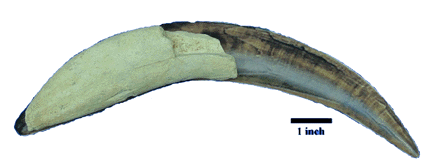
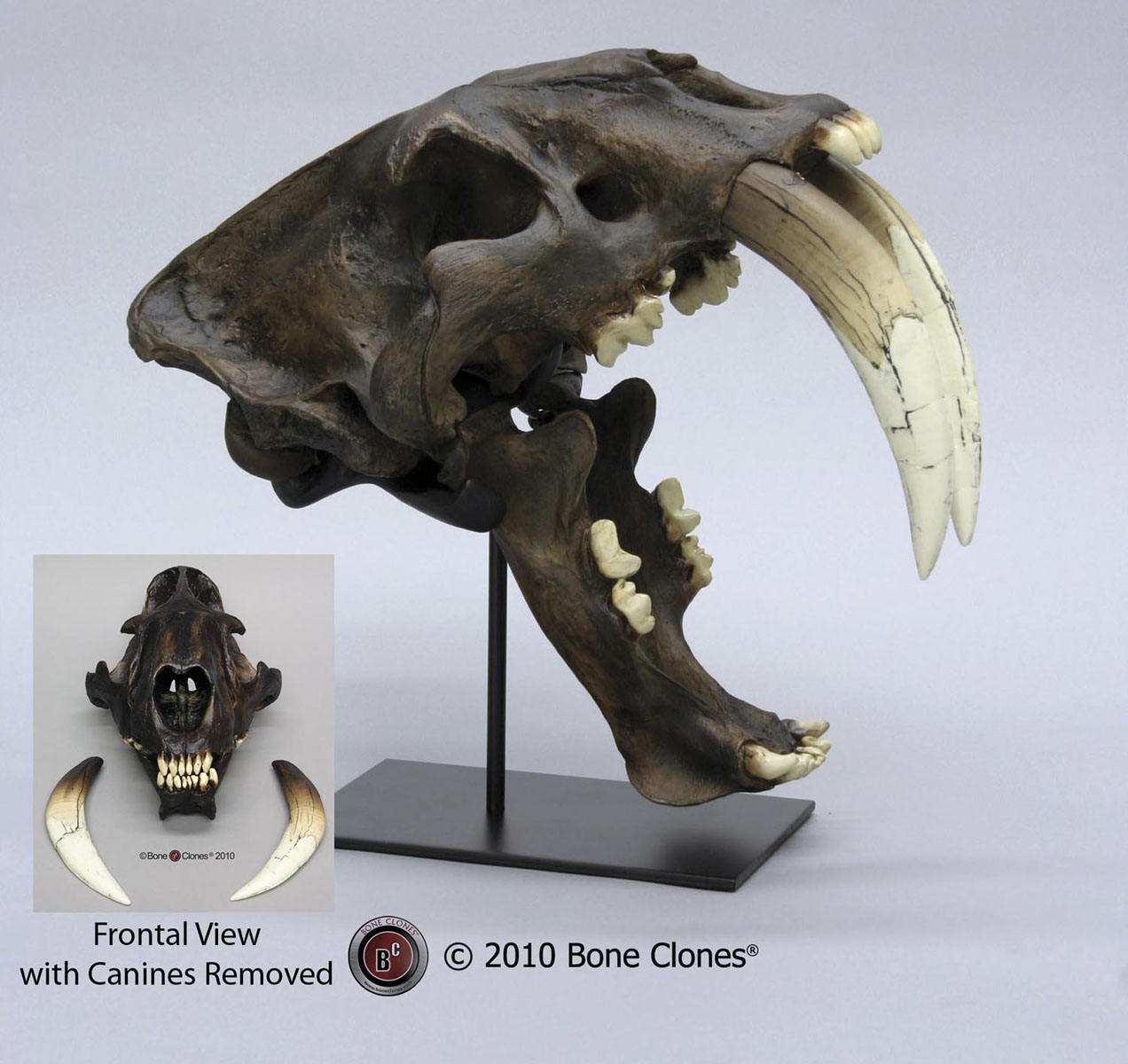 The tooth is a canine from a Smilodon, the saber-toothed tiger (although not actually related to tigers). Smilodon fossils have been found in a few caves in the Ozarks of northern Arkansas, most notably Hurricane River Cave and the Conard Fissure (the Conard Fissure was excavated by Barnum Brown for the American Museum of Natural History, who also did a lot of famous dinosaur digs for them in the Rockies) . Originally, they were described as having come from two different species of Smilodon: S. fatalis and S. floridensis. Smilodon fatalis, sometimes called S. californicus, is well-known from the La Brea Tar Pits in California, although has been found throughout much of North America and Pacific coastal areas of South America. Smilodon floridensis was known primarily from, unsurprisingly, Florida and neighboring states. However, these days most researchers view them all as the same species, so just Smilodon fatalis. There are two other recognized species. Smilodon populator lived in South America and was bigger, with a few hundred more pounds on S. fatalis. Smilodon gracilis was half the size of S. fatalis and lived earlier than either of the other species, and is considered by some to be ancestral to them.
prehistoricpark.wikia.com
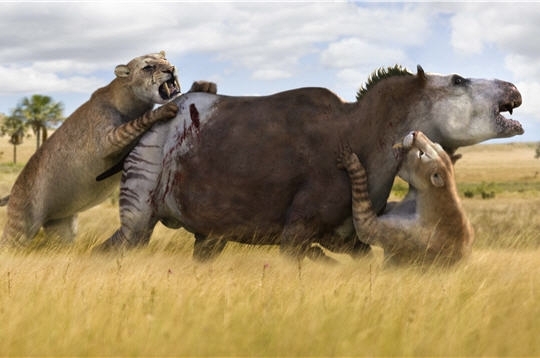
Smilodon fatalis is the quintessential Ice Age predator. It appeared about 2.5 million years ago and only died out about 10-13,000 years ago, so it may have been possible that Smilodon preyed upon early humans, at least along the Pacific coastal areas. It was a big, burly cat weighing up to 600 lbs. with heavily muscled forelimbs. Of course, it is best-known for its 7” long, serrated canines, thus the name Smilodon, meaning “carving knife tooth”. Smilodons were part of a group known as Machairodontinae, a subfamily within Felidae known as the “dirk-toothed cats.” These long teeth necessitated a jaw that could swing extraordinarily wide. Smilodon was specialized for killing large prey, such as bison, horses, and young mammoths and mastodons. Much debate has centered on how it dispatched its prey, with depictions of a Smilodon burying its canines in the skull or eviscerating its prey. However, more recent studies have indicated the canines were too fragile to withstand such treatment or couldn’t get a sufficient bite to properly tear into the abdomen. It is thought instead that Smilodon used its powerful forelimbs to stun and restrain the prey until it could bring its canines into play with its powerful neck muscles to slash the throat and cut the major arteries, causing the animal to bleed out quickly. They were not fast runners, preferring to attack from ambush, staying hidden within the vegetation of the forests and bushlands it preferred to live in.
Youngsteadt J.O., 1980: A saber toothed cat smilodon floridanus from hurricane river cave northwest arkansas usa. Nss Bulletin: 8-14
B. Brown, The Conard Fissure, A Pleistocene Bone Deposit in Northern Arkansas…,Memoirs of the American Museum of Natural History, Vol IX, Part IV, February 1908.
Mystery Monday

Today we have a picture by Ronny Thomas of a very well-known animal, although it is quite rare in Arkansas. In fact, only one has ever been found in the state. So what do you think it is? Stay tuned for the answer on Friday.
Fossil, and Forum, Friday
I’m sorry, but I forgot to post the Mystery Monday fossil on the blog. I posted the fossil on the Facebook page, but somehow failed to get it posted here, for which I apologize. Here is the fossil I posted, including the identifying portion cropped from the original picture. This image was taken from trilobites.info, a great website for all things trilobite.

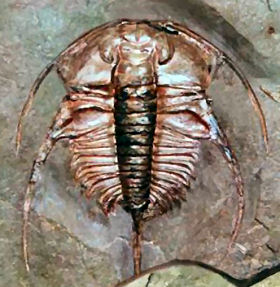
Here is Bristolia for comparison. This image is also from trilobites.info
It was correctly identified as a trilobite, although this one is the species Irvingella, not Bristolia as was guessed. Irvingella is very similar, but lacks the tail spine and the second set of spines is a little farther down the body. They are both listed as “fast-moving low-level epifaunal” feeders by the Paleobiology Database, which means they scurried quickly about over the ocean floor. But whereas Bristolia is thought to have been a deposit feeder, much like a crawfish, Irvingella was a carnivore, preying on worms, bugs, and such. They both lived in offshore marine environments, but whereas Bristolia has been found mostly in shallower waters, Irvingella has been found widespread from offshore throughout the continental shelf and even deeper water. This may have more to do with Bristolia having only been found in a few places in the southwestern United States while Irvingella has a much broader range throughout much of North America and Asia. They both lived in the Cambrian Period, although Bristolia seems to have lived a little earlier than Irvingella (there are some discrepancies in the published records making it difficult to compare exactly, this is partly due to revisions of the time scale and refinements in age estimates over the decades making detailed comparisons problematic).
Since our last Forum Friday recap, we have started a new year. We have reviewed the Walking with Dinosaurs movie. We identified an Exogyra ponderosa oyster, Archimedes bryozoan, Aetobatus eagle ray, and this Irvingella trilobite.
Over on the Facebook page so far this year, we have seen some amazing animals, including sharks that glow in the dark, a fish that walks on land, and a caterpillar who’s tobacco breath repulses spiders. We even learned why sharks don’t make bone, but polygamous mice have big penis bones and an organism that changes its genetic structure seasonally.

A green biofluorescent chain catshark (Scyliorhinus retifer). Livescience.com. Credit: ©J. Sparks, D. Gruber, and V. Pieribone
We saw two articles on fighting dinosaurs. We learned how they took over the planet and discussed scaly dinosaurs for a change. We found out some ancient marine reptiles were black and Tiktaalik had legs.
A lot of articles hit the press on human evolution in 2013. We also found out (some) humans developed the ability to tolerate lactose to not starve and how we smell sickness in others. We also found a great book on Evolution & Medicine. We also saw evidence of how our actions affect the evolution of other animals and someone who thinks they can understand dog language.
We read that plants may have caused the Devonian extinction event, a genetic study saying placental mammals originated before the end-Cretaceous extinction event despite no fossils ever having been found, and that small mammals with flexible schedules handle climate change better than big mammals that keep a stricter schedule.
We found a great , concise explanation of evolution and three different short videos on the history of life on earth, two of them animated and set to music. We also heard Neal DeGrasse Tyson urge more scientists to do more science outreach (and how to cook a pizza in 3 seconds). Unfortunately, we also heard about the deplorable conditions during filming on Animal Planet and creationism in Texas public schools, as well as how the failure to take evolution into account can screw up conservation efforts.
So what did you like? Did you guess the fossil? Is there anything you want to see? Let us know.
Fossil Friday
Another week has gone by and so little done here. I started my Vertebrate paleontology class this week and if you think it takes a lot of work to take one, just imagine the amount of time it takes to design one.
So today, we announce the mystery fossil from Monday. Did you have any idea what it was? It stumped everyone on the Facebook page, so if you couldn’t figure it out, don’t feel bad. It was a hard one. These are not terribly uncommon fossils, but most people are completely unfamiliar with them, despite the fact that anyone who visits a public aquarium has seen its living relatives.

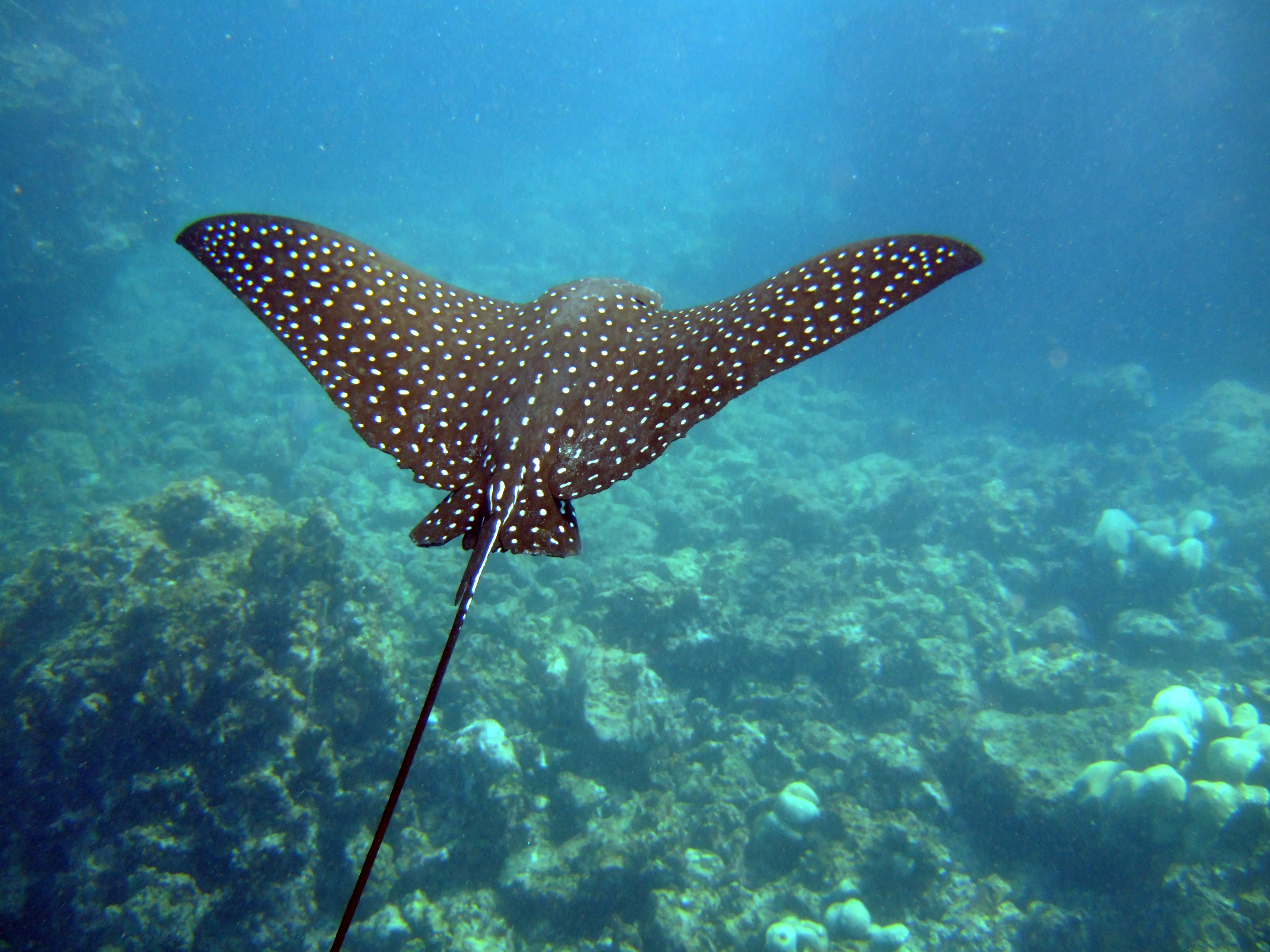
This is part of a tooth plate from a ray, most likely Aetobatus, the eagle ray. They are filter feeders eating plankton and have been around since the Miocene 20 million years ago. While none have been found in Arkansas that I know of, they have been found in pretty much every state around us, so I expect so collector out there somewhere has probably found some here. Check us out Monday for a new fossil!
Spotted_Eagle_Ray_(Aetobatus_narinari). Wikipedia.
UPDATE: I need to correct a mistake I made in this post. Eagle rays, like Aetobatis here, were and are not filter feeders. The large rays, like the Manta ray in the same family, are indeed filter feeders, the smaller rays, like Aetobatus and its close relative Myliobatis, another ray that lived in the area at the same time (as well as earlier in the Eocene over 40 million years ago), were durophagous, meaning they used their teeth to crush shelled prey, such as clams, crabs, and shrimp. The main part of the tooth brought to bear on the prey item is the flat, plate-like part.
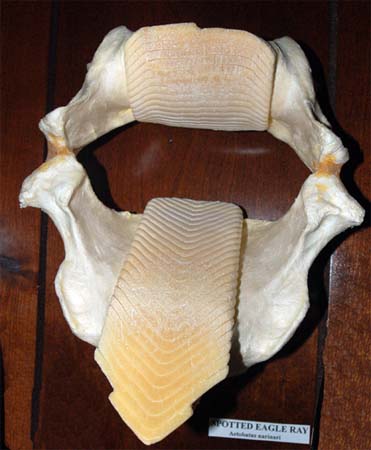 For this picture and much more information on the current species of eagle rays, go to the Florida Museum of Natural History.

 paleoaerie